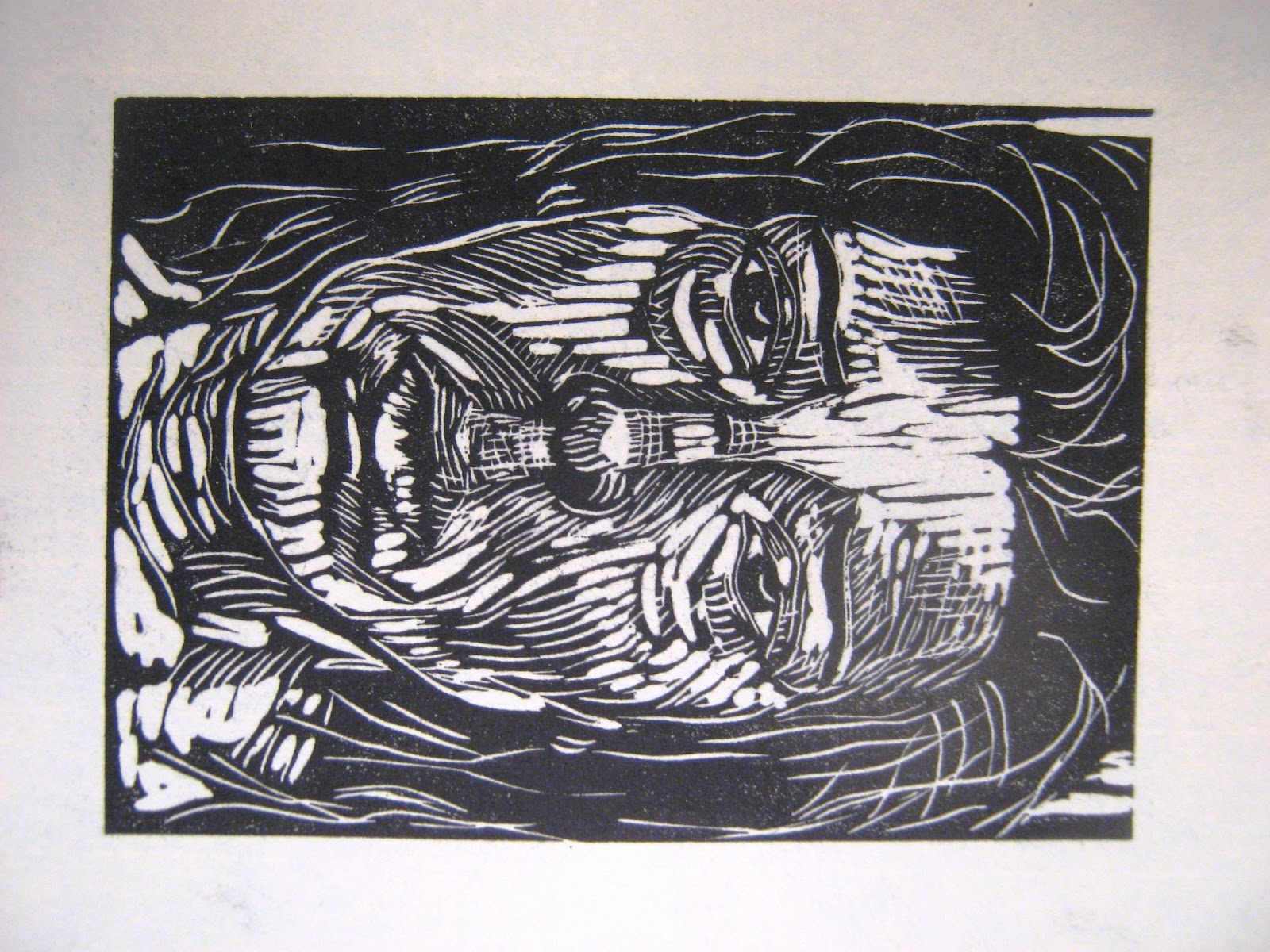
You know, every once in a while the chance to go see some art in a really great museum comes along, and how often do we actually go? Personally speaking, Not as much as I would like. Sooooo, in an effort to encourage my fellow inked up brethren and sisters to go see some mighty, mighty fine prints, here is a list of the top 22 institutions (western world) whose collections kick collective butt. I am a bit surprised to see that the US only registers 5 out of the group, but hey, there are a few places on the list any printmaker would be pleased to make a pilgrimage to see some dry ink on old paper. So collect the kiddies, students, and colleagues and bypass that over-hyped and over-rated show in Venice this summer and go visit France, UK, Austria, the Netherlands, Spain, Russia and Germany. You'll be glad you did.:)
British Museum, London, UK
50,000 drawings, 2 million prints
The Metropolitan Museum of Art, New York, US
15,000 drawings, 1.5 million prints
Albertina, Vienna, Austria
50,000 drawings, 1 million prints
Excludes 25,000 architectural drawings
Kupferstichkabinett, Berlin, Germany
110,000 drawings, 500,000 prints
State Hermitage, St. Petersburg, Russia
39,000 drawings, 486,000 prints
Victoria & Albert Museum, London, UK
2,000 drawings, 500,000 prints
Excludes 600,000 architectural drawings, 100,000 design drawings and 10,000 British drawings
National Gallery in Prague, Collection of Prints and Drawings, Prague, Czech Republic
60,000 drawings, 400,000 prints
Cabinet des Estampes et des Dessins, Strasbourg, France
200,000 prints and drawings
Fitzwilliam Museum, Cambridge, UK
20,000 drawings, 180,000 prints
Royal Collection, London, UK
40,000 drawings, 150,000 prints
Including 600 drawings by Leonardo da Vinci
Musée du Louvre, Paris, France
140,500 drawings, 43,000 prints
The main print collection is at the Bibliothèque nationale de France.
Philadelphia Museum of Art, Philadelphia, US
150,000 drawings and prints
Uffizi, Florence, Italy
120,000 drawings and prints
Bibliothèque de l'Arsenal, Paris, France
100,000 prints
Art Institute of Chicago, Chicago, US
11,500 drawings, 60,000 prints
Musée des Beaux-Arts, Dijon, France
10, 500 drawings, 60 0000 prints
Musée des Beaux-Arts, Orléans, France
10,000 drawings, 50,000 prints
Museum of Modern Art, New York, US
6,000 drawings, 50,000 prints
Includes more than 4,000 Old Master drawings and excludes over 10,000 architectural drawings
Brooklyn Museum, New York, US
2,000 drawings, 40,000 prints
Museo del Prado, Madrid, Spain
9000 drawings and prints
Zelandia Illustrata, Amsterdam, Netherlands
18,000 maps, prints, drawings, photographs, glass negatives, slides and postcards
A place for talking about art, social issues, and most anything else I think THAT'S INKED UP.
Sunday, July 28, 2013
Friday, July 26, 2013
Richard Tretault's Engagement with Youth and Passages
Richard Tretault is an artist living in Vancouver, Canada. His career has been spent looking at his surroundings and getting a feel for life on the street. His fascination with the urban landscape is long-standing, so much so that he often has worked to improve the quality of arts found in an urban setting by working on murals and large-scale projects. His interest in this area led him to coordinate with the Canadian-based LaRaza, bringing arts to public spaces in Canada, Argentina and Mexico.
Tretault’s prints have the same feel as his other works, meaning they have an expansiveness, both in actual scale and the allegorical images they project. The bold brushwork and color of his images show us a person working uninhibited in the medium. He brings forth a liveliness and an underlying pulse of the people living in his environments.
The doorways, or passageways, some broken and falling apart let us equally enter and exit the image. The faces of youth, contrasted against the broken down environment show that youth will always carry on into the future. The strength of his lines, collaged sections and angles harken to the Expressionists, but where he differs from them he allows vibrant and passionate color work push and pull the compositions like a Hans Hoffmann painting.
Tretault's series about Cuba and its culture speak about it enduring struggle to survive in the face of overwhelming societal and governmental sanctions. The strata of their lives in Cuba is fraught with obstacles, yet it is a culture full of music and creativity.Doors are closed tot he outside public, and crows or vultures seems to await those that venture outside its confines, but the birds have nothing to eat, and the doors are alive with within. Nothing will keep them from being the creative, inventive people they are.
Likewise, Tretault's portraits of Cuban youth amidst broken or cubistically-collaged objects in their environment, like a bicycle or an angel floating overhead(whether figurative or allegorical) it is there watching over them protecting them from evil. They will defiantly stand their ground and fix that broken bicycle or 1950s car as many times as it takes because it's all they have. They will survive because they have to.
This final portrait collages the elements of the Caribbean, the waves, the breeze blowing through the palm trees, and the face of this young man, ever-watching for his opportunity to break free of the confines of his country. I ascribe my thoughts upon these pieces, but I sense and feel Tretault's warm breezes blowing over the land and the youth's skin. On the surface the place isn't so bad, but the translucency of Tretault's printings underscore hidden feelings and suppressed ambitions. They are strong, powerful compositions that engage us through color and linear details, but we are more fascinated by what is not seen and what is unknown about a culture that as been virtually isolated for 50 years.It's as though Tretault is saying, 'open the gates and let us in', for there is much to discover and much to learn about the arts and people of this little island nation. I hope someone listens to Tretault's images and lets us do just that. http://www.richard-tetrault.ca/
Sunday, July 21, 2013
Taiwan’s LIAO SHIOU-PING : Where East Meets West
LIAO SHIOU-PING was born in Taiwan in 1936, the son of a civil engineer. As a child, he would often study architectural blueprints spread across his father’s desk. His family lived near Taipei’s famous Longshan Temple and it helped formed strong influences upon his artwork.
The name Shiou-Ping Liao is practically synonymous with printmaking in Taiwan. Dedicated to promoting modern Taiwanese printmaking, Liao has made significant contributions to the development of modern printmaking in Taiwan and China. Liao’s art education started at the National Taiwan Normal University. In 1959, he moved to Tokyo, Japan to study at the Tokyo University of Education (now the University of Tsukuba), and then moved to paris France to study at the Fine Arts Institute of Paris, and Atelier 17. He studied painting, graphic design and printmaking. When he was in Paris, one of his instructors pushed him to find his own style, and he began to explore his Asian roots as a source of inspiration. He drew on memories of the candles, incense and ghost money from Longshan Temple for much of his later work. In the late 1960s he loved to New York where he developed his Symbols series, inspired by Taiwanese culture. Liao believed that “an artist’s style reflects the rhythms of the society that he lives in.”
Liao has devoted himself to creative expression and exploration, developing visual art to express the character, customs, faith, and lifestyles of his people. Liao’s work incorporates Asian sensibilities with a strong graphic design. It is work full of personal symbols and rich in Eastern art colors like red, gold and black; describing a longing for harmony, balance and beauty. He has found a way to bridge Eastern and Western ideas, techniques, and formats, creating a series of works of unique symbols which derive from inscriptions on ancient bronze, drawings of antique ceramics, and Chinese religious, folklore art and gates which reflect secular and divine connections.
In the mid 1970s, Liao returned to Taiwan where he bagan to teach at the National Taiwan Normal University. He developed a textbook on printmaking, The Art of Printmaking, which is still the Bible of printmaking techniques in Asia. He later taught in Tokyo and the US. In the 1990s, he spent time in mainland China teaching western printmaking techniques and spreading an enthusiasm for the medium. Liao’s wife unforeseen death in 2002 inspired his Dreams series where he conveys the duality of yin and yang, life and death, through images of outstretched hands and ghost money.
During his career, Liao Shiou-ping has held more than 70 solo exhibitions in New York, Paris, Tokyo and many other cities around the world. His work can be found in the following permanent collections:
The British Museum
The Metropolitan Museum of Art in New York
the National Museum of Modern Art(Tokyo)
Taipei Fine Arts Museum
The Shanghai Museum
Awards:
Recipient of the Nation Cultural Award and National Award for Arts, earning the title of “father of modern Taiwanese printmaking” for his outstanding artistic achievements.
Co-Founder of the Prix de Paris fund to provide support for young artists to study abroad.
The name Shiou-Ping Liao is practically synonymous with printmaking in Taiwan. Dedicated to promoting modern Taiwanese printmaking, Liao has made significant contributions to the development of modern printmaking in Taiwan and China. Liao’s art education started at the National Taiwan Normal University. In 1959, he moved to Tokyo, Japan to study at the Tokyo University of Education (now the University of Tsukuba), and then moved to paris France to study at the Fine Arts Institute of Paris, and Atelier 17. He studied painting, graphic design and printmaking. When he was in Paris, one of his instructors pushed him to find his own style, and he began to explore his Asian roots as a source of inspiration. He drew on memories of the candles, incense and ghost money from Longshan Temple for much of his later work. In the late 1960s he loved to New York where he developed his Symbols series, inspired by Taiwanese culture. Liao believed that “an artist’s style reflects the rhythms of the society that he lives in.”
Liao has devoted himself to creative expression and exploration, developing visual art to express the character, customs, faith, and lifestyles of his people. Liao’s work incorporates Asian sensibilities with a strong graphic design. It is work full of personal symbols and rich in Eastern art colors like red, gold and black; describing a longing for harmony, balance and beauty. He has found a way to bridge Eastern and Western ideas, techniques, and formats, creating a series of works of unique symbols which derive from inscriptions on ancient bronze, drawings of antique ceramics, and Chinese religious, folklore art and gates which reflect secular and divine connections.
In the mid 1970s, Liao returned to Taiwan where he bagan to teach at the National Taiwan Normal University. He developed a textbook on printmaking, The Art of Printmaking, which is still the Bible of printmaking techniques in Asia. He later taught in Tokyo and the US. In the 1990s, he spent time in mainland China teaching western printmaking techniques and spreading an enthusiasm for the medium. Liao’s wife unforeseen death in 2002 inspired his Dreams series where he conveys the duality of yin and yang, life and death, through images of outstretched hands and ghost money.
During his career, Liao Shiou-ping has held more than 70 solo exhibitions in New York, Paris, Tokyo and many other cities around the world. His work can be found in the following permanent collections:
The British Museum
The Metropolitan Museum of Art in New York
the National Museum of Modern Art(Tokyo)
Taipei Fine Arts Museum
The Shanghai Museum
Awards:
Recipient of the Nation Cultural Award and National Award for Arts, earning the title of “father of modern Taiwanese printmaking” for his outstanding artistic achievements.
Co-Founder of the Prix de Paris fund to provide support for young artists to study abroad.
Labels:
Atelier 17,
gates,
Longshan Temple,
Paris,
Taiwan,
Tokyo
Saturday, July 13, 2013
The Fluidity of Ryan McGinness' Semiotics
Ryan McGinness’ prowess in printmaking circles is becoming
quite a known entity. His eye-catching, crisp and clean logo-like motifs are complex
in their subject and when overlapped or placed next to other motifs, they
sometimes create other shapes. The artists’ homage to semiotics and mass-commercialism is
apparent, and his works are widely seen in galleries, online sources, and online
merchandising. I will, however, speak to his work in this article.
McGinness is more
known as a young, up-coming painter who has received enormous attention for his
intricately, over-lapping designs. They can, at times, resemble the complexity
of viewing Islamic designs within a majid, or a host ot graffiti-like tattoos, but his subject matter is more
far-reaching, incorporating known designs and creating his own logos for religious
symbols, the human form and animals, etc. To McGinness, the more exotic his references
are, the better. The end result of these complex combinations
is often successful when applied to his paintings, but his prints aren’t as
heavily drenched in color nor in subject. Nor do they need be.
He often lets the white of the printed paper show through and around hsi subjects and it
creates a shape of its own. Some of his prints don’t appear ‘finished’ - like some of Paul Cezanne’s watercolors left an
openness of the paper for the viewer to fill in the gaps. I can’t say I think
McGinness is attempting the same dialogue. To be honest, it would appear that his
message isn’t even about the subject-ness of his designs and logos. He appropriates
form for building other types of shapes, but as for some inner meaning or
referential point, McGinness doesn’t mention anything in particular, and their
vagueness leaves one detached. His
deliberate avoidance for some compositional device(more seen in his prints) may
also be a form of anti art-statement. In some cases, I am reminded of the work
of Carrie Plank, whom I wrote about earlier this year. Her sensibility for combining
recognizable form was so disparate, that one couldn’t connect the dots of
meaning in her work. Here, I am close to making the same assessment with
McGinness’ work, although he does control the design of his logos and their
uniformity is in his use of their flat, bright colors.
Where McGinness’ paintings are saturated with line and form
and visual “POW!” , his prints are just as complex in their single use of
color. I, too, understand wanting to try ‘something else’ in other media, so one
can see the artist’s thought-process at work.
I do like the artist’s energy and the fact he is seems to be
ever-exploring his imagery.
McGinness’ expansion from geometric form to fluid curvilinear
motifs moves us through some earlier 20th c. art movements like Op
Art and the Semiotics of the 1980s, Multi-culturalism and tattoo-graffiti of the
1990s to now. The multi-ethnic source material will be interesting to see evolve,
as it has been with earlier artists’ work, but the ambitious nature of his
overall projects and producing them in other cultures speaks to the works of
his predecessors Keith Haring and Jean-Michel Basquiat. We will hope his longevity transcends theirs,
as this own path moves forward.
Sunday, July 7, 2013
"All Stars" by Teresa J. Parker debuts at Museo Tecleno MUTE
Greetings to all my inked up comrades.
Pardon my brief online absence as I have been feverishly at work preparing for my first ever museum exhibition. The making of new work is never as arduous as its shipping and anticipated safe arrival to parts far flung. I am pleased to report that four new series of prints and drawings will debut July 12th at the Museo Tecleno MUTE, a suburb of San Salvador, in Santa Tecla. The series for this exhibition are: 1) the ‘Baby Bird Suite’, prints conceived in part from Francisco de Goya's Caprichos prints, about illegal adoptions in Central America, 2) ‘Battered Madonnas’, which debuted in Guatemala in 2012, is about making iconic madonnas out of domestic violence victims, 3) the ‘All Stars’ is a new print series about the growing occurrence of filicide, and 4) ‘Domestic Bliss’ are new drawings tying together the theme of Battered madonnas. Many thanks to my art comrade and friend John Sevigny for including me in this joint exhibition of our works. Sevigny will be showing his now well-known "NOMADS" project, on the subject of migration from Central America through Mexico.
While I am loathe to go into much detail about my own work, I am posting this new project here for your review. (Warning* The subject of this series may be difficult for some readers.)
The ‘All Stars’ project came about as an extension of my long-standing theme relating to women and children. My earlier series, the Battered Madonnas, previously shown in Guatemala and Mexico, discusses in visual form the physical and spiritual scars of domestic violence - a topic not much discussed. My current project “All Stars” also crosses a bridge not often discussed, except in hushed tones and to make one shudder. Filicide is a growing phenomenon, and the alarming number of occurrences in the United States alone is staggering and heart-breaking. It’s a subject I don’t pretend to understand, nor condone, but as a mother and an artist, I feel I must make a statement. The exhibition contains twelve portraits of women charged and convicted of filicide, although I am only displaying ten here.
The nature of madonnas(young mothers) and matriarchs is to nurture and care for their children and their extended families. It is a natural and sacred responsibility that has been in place since the dawn of humankind. Yet, as present global events and situations take their emotional, physical and spiritual toll upon men and women, something essentially human is breaking down. The nature of familial units separate, grow distant and sometimes break apart. No one can conceive how a mother could take the life of her child, but it does happen, and the reasons are varied. This series is a structural look at the faces of these women and caregivers. There is no one thing that speaks to their individual circumstances, rather I chose in these prints to de-personify these subjects, to look at them as objects, yet elements of their personalities came through. I will let you view them without further comment, but it is hoped that you will share your impressions with your colleagues, family and friends.
Pardon my brief online absence as I have been feverishly at work preparing for my first ever museum exhibition. The making of new work is never as arduous as its shipping and anticipated safe arrival to parts far flung. I am pleased to report that four new series of prints and drawings will debut July 12th at the Museo Tecleno MUTE, a suburb of San Salvador, in Santa Tecla. The series for this exhibition are: 1) the ‘Baby Bird Suite’, prints conceived in part from Francisco de Goya's Caprichos prints, about illegal adoptions in Central America, 2) ‘Battered Madonnas’, which debuted in Guatemala in 2012, is about making iconic madonnas out of domestic violence victims, 3) the ‘All Stars’ is a new print series about the growing occurrence of filicide, and 4) ‘Domestic Bliss’ are new drawings tying together the theme of Battered madonnas. Many thanks to my art comrade and friend John Sevigny for including me in this joint exhibition of our works. Sevigny will be showing his now well-known "NOMADS" project, on the subject of migration from Central America through Mexico.
While I am loathe to go into much detail about my own work, I am posting this new project here for your review. (Warning* The subject of this series may be difficult for some readers.)
The ‘All Stars’ project came about as an extension of my long-standing theme relating to women and children. My earlier series, the Battered Madonnas, previously shown in Guatemala and Mexico, discusses in visual form the physical and spiritual scars of domestic violence - a topic not much discussed. My current project “All Stars” also crosses a bridge not often discussed, except in hushed tones and to make one shudder. Filicide is a growing phenomenon, and the alarming number of occurrences in the United States alone is staggering and heart-breaking. It’s a subject I don’t pretend to understand, nor condone, but as a mother and an artist, I feel I must make a statement. The exhibition contains twelve portraits of women charged and convicted of filicide, although I am only displaying ten here.
The nature of madonnas(young mothers) and matriarchs is to nurture and care for their children and their extended families. It is a natural and sacred responsibility that has been in place since the dawn of humankind. Yet, as present global events and situations take their emotional, physical and spiritual toll upon men and women, something essentially human is breaking down. The nature of familial units separate, grow distant and sometimes break apart. No one can conceive how a mother could take the life of her child, but it does happen, and the reasons are varied. This series is a structural look at the faces of these women and caregivers. There is no one thing that speaks to their individual circumstances, rather I chose in these prints to de-personify these subjects, to look at them as objects, yet elements of their personalities came through. I will let you view them without further comment, but it is hoped that you will share your impressions with your colleagues, family and friends.
Friday, June 14, 2013
John Abell Explores Gallows Humor on Love and Life
British artist John Abell is making a splash with his large scale relief prints.These mega-inked up babies bring with them a microcosm of art historical references which allows the viewer to move through late 19th c. early 20th c image-making. Abell's interest to make the image a life-sized scale is not a purposeful decision as much as it is opportunity. You see, he uses available materials. The scale of the piece is the scale of the matrix. Plain and simple. The guy doesn't believe in wasting useful printing surfaces. Gotta love him for that. (Face it, most printmakers are a resourceful lot, and we've all re-used matrixes before.)
Abell maximizes his whole picture plane, and one finds fractured scenes with main characters and subplots, as one would find in a novel. His descriptions of love and sacrifice, of losing on'e head(quite literally cut off) from one's body is a little ghoulish, but meant in good humor. We all lose our heads when we're in love, or in fascination. As figures pine away for their beloveds, or stare at us complacently with their limbs detached and lying about, one ponders the sense of emotional or real pain one suffers in the course of a day or a life.
The physical carvings or wounds upon Abells' matrix compliment the subject well. His references to the works of German Expressionist printmakers is clear, but he fills up the pictures with lots of flowing rivers - of blood, perhaps, for the work is in black and white, and if presented in color, might seem overpowering or repulsive. The animated quality the work retains lets us look endlessly through the compositions and want to touch their printed paper surfaces.
Complicated passages of people passing through time, lost love, childbirth and impending death weave seamlessly together. We are curious where these subjects come from, but there is a whole history of cartoonish gallows humor. These are less cartoon-like, but harken back to more medieval times, where a 'how to be a good christian' prophesy and faith were more intertwined in one's daily existence. They are refreshingly simple, yet complex, and encourage us to break with printmaker's traditional scale to produce images we feel we can walk into.Bravo!
Abell pictured below printing an image in his apartment.
johnabell.blogspot.com/
Labels:
Bristol,
German Expressionists,
John Abell,
Woodcuts
Sunday, June 2, 2013
Julia Goos Pence's Prints of a Re-consructed History
Julia Goos Pence is an artist who lives and works in Oregon. She one of the artists participating in Monoprint 2013 at University of Stevens Point (May 31-June 6). I support of this project, I am reviewing some of the artists in this year's event.
After spending time with her work, http://www.juliagoospence.com/, one perceives her search for history; for ancient structures, cultures and places where people have come to a place to settle, put down roots, only to be displaced or abandon their homes. There isn't a sense of destruction in the sense that Adrian Barron's work portrays where homes are being burned down. Pence gives us diagrammatic structures that seem to be projections or layouts of what will be a settlement. Her drawing sensibility is securely set in linear perspective. But then she throws in a hearth fireplace without the home, a symbol of the core of the family activities. Pencil thin sticks make up fragile fort-like structures, or a clustering of trees as some form of natural defense against the danger of the wilds. Still other prints reveal what appear to be temple-like structures found in ancient Greece or Stonehenge.
In this series, Pence's colors are muted and faded, like memories of places one's seen but they're not tangible enough to hold long in our consciousness. There are soft flat bands of color that permeate the linear space and they create small barriers to navigate the compositions. Their seemingly random placements aren't, for they build patterns often seen in quilt-making. Again, the suggestion of a home-making activity reserved historically for women, but veiled under these circumstances.
More contemporarily, some of Pence's imagery relates to the other-worldliness of Mies van der Rohe's early skyscraper diagrams from the 1920s, but her spatial depth and emptiness is more keenly attuned with the mammoth drawings of Anselm Kiefer and the shipyard prints of Robert Stackhouse. Her subtle reference to feminist artist Joyce Kozloff may not be conscious, but it is implied.
This curious blend of seeking out one's destiny and planting roots in a vast emptiness, coupled with the intent to provide safety and secutiy through the patchwork quilt designs, shows Pence's an understanding of the nature of man - to settle down, have a family, survive the elements. It's a story ingrained in every culture since the dawn of mankind. Her work ably continues that legacy.
Subscribe to:
Posts (Atom)


.jpg)