Saturday, November 16, 2013

Happy (?) Jamaican Slaves via the Prints of Isaac Mendes Belisario

Isaac Mendes Belisario (1795-1849), has been described as the first documented Jamaican artist, but he was raised for a time in London, studied art and then worked as a stockbroker before returning Kingston, Jamaica, (a British colony) in the early 1830s. He became a well-known artist, painting landscapes and state portraits of important colonial residents, but he also made prints about the island’s local slave population. His work provides a rich description of Jamaican life at the time of the Emancipation, and while some of his observations seem one-sided according to today’s state of political correctness, they do enlighten us about slaves’ daily activities, and celebrations.
Belisario was a member of the Sephardic Jewish merchant class, who worked in retail, wholesaling, and dealt in the country’s slave trade. In 1831, Jamaica’s Assembly proclaimed the Jewish Emancipation Act, which allowed great freedoms for Jews versus the more restricted existence in London. One of Belisario’s distant relatives was briefly imprisoned by the Spanish Inquisition in 1656, before escaping to London. The other side of his family were in the opera and performed for the King of Spain. Another relative, Isaac’s uncle Jacob, was an art dealer, stockbroker and participant in a huge embezzlement scheme of the day.
Born in Kingston in 1794, Belisario was named after his grandfather, the Rabbi Isaac Mendes Belisario (1719-1791), of the Bevis Marks Synagogue in London. One of the Rabbi's sons, Abraham Mendes Belisario came to Jamaica in 1786 where he was employed by Alexandre Lindo, who was one of the wealthiest Jews on the island. Abraham married Alexandre's daughter, Esther, and he was made a partner in Lindo's business, When faced with bankruptcy, Isaac Mendes Belisario's father left his family in London, looked for a job and soon found himself in the West Indies, in Tortola, where he became the manager of seven sugar plantations. He was horrified to see how cruelly the slaves were treated and eventually served on a jury of the first white man brought up on murder charges for killing a slave in Tortola. He wrote an unsuccessful report calling for protection for the treatment of Africans in the West Indies. In addition, the artist’s maternal grandfather was involved in the finances of the Haitian revolution.
In 1837-38, Belisario made a series of hand-colored prints based on a holiday carnival practiced for decades by slaves, called " Sketches of Character In Illustration of the Habits, Occupation and Costume of the Negro Population in the Island of Jamaica " they were accompanied with detailed ethnographic texts. Although slavery was abolished in Jamaica in 1833, these prints were very telling about the perception of the lives of slaves, both before and after emancipation, and they are still very popular in Jamaica.
In tracing the West African roots of Jonkonnu and its evolution in Jamaica, it had its origins with Jon Konny, a celebrated Nzema chief who ruled over Prince's Town in the 17th and 18th centuries in what is now Ghana. The Jonkonnu masquerades became very elaborate, as they incorporated the traditions of other African peoples and even some European carnival traditions. If anything, Jonkonnu was a leveller of slave society where the great Jamaican houses were opened up to the slaves who "drank with their masters and spoke with greater familiarity"; the distance between them briefly forgotten.
All the images represent happy, smiling slaves, well-dressed in theatre European style costumes with fancy wigs and jewelry. He felt the power of these fascinating carnival scenes of slaves. Some of these parades and competitions borrowed from Shakespeare characters. In a blend of carnival and east African dance traditions, the "Jack-in-Green" image at the bottom of this article, we find a barefoot figure in the center of the image, where an initiate’s body is completely hidden by a mask on its face and long vegetable fibers cover the body. Black women in European costumes dance about the covered figure like moths to a flame. Belisario also includes in these images a masked dancer, John Canoe, who was a chief of the village in the Gulf of Guinea, working in the 1720s.
Isaac M. Belisario was not a well man; suffering from tuberculosis. He seems to have never married; nor had any children, although he still has collateral descendents in Jamaica and Australia. His last documented print was produced in 1846, and he is known to have died in London three years later. A book about this artist’s enthralling past has recently been published.
Exhibitions:
Royal Academy
the Society for Painters in Oils and Water-Colours
His prints were produced working with the French printmaker Adolphe Duperly.

Monday, November 11, 2013

Josef Albers' Fetish for A Colored Square: Prints

The teachings of Josef Albers are legendary in art education circles, but his work in color theory and design is equally important. Born in Germany to a family of craftsmen, Josef Albers (1888 – 1976) worked in furniture and glass before teaching painting and engaging hords of students eager to have the opportunity to work with the famed educator. His work in printmaking was brought to my attention via my mentor and teacher, Robert Wolfe. We were encouraged to do hundreds of color studies abeit in the manner of Albers and try to understand the delicate balances of color in our own works. I didn’t claim to take to Albers ideas at the time, but eventually I saw, as have thousands, his pain-staking research advanced ideas on color and design.

At the age of 20, Albers taught school in his home town, then he went to Berlin to study art education at the Königliche Kunstschule, (1913-1915). For three years, 1916-1919, he began to make prints at Essen’s Kunstgewerbschule, and in 1919 he went to Munich, Germany, to study with Max Doerner and Franz Stuck at the Königliche Bayerische Akademie der Bildenden Kunst.(Try saying that five times fast. See, you can't do it.)

Albers enrolled at the prestigious Weimar Bauhaus in 1920. He joined the faculty of the Bauhaus two years later. The director and founder of the Bauhaus, Walter Gropius, asked him to teach Design to introduce principles of handicrafts. In 1925, Albers was promoted to professor, the same year the Bauhaus moved to Dessau. He also married one of the school’s students, Anni Fleischmann, who would become well-known for her own textiles designs. Albers was teaching with Oskar Schlemmer, Wassily Kandinsky, and Paul Klee. Klee and Albers collaborated in glass and crafts for several years. Under pressure from the Nazi party, the Bauhaus closed in 1933 and most of its artists left Germany. Albers then emigrated to the United States.

The famed architect Philip Johnson arranged a position for Albers as head of a new art school in North Carolina, called Black Mountain College. He led its painting program until 1949. Some of Albers’ notable students were Ray Johnson, Robert Rauschenberg, Cy Twombly, and Susan Weil. He also invited Willem de Kooning, to teach in the summer session. During this period, Albers produced many woodcuts.
In 1950, Albers left Black Mountain to head Yale University’s department of design. While there, Albers worked to expand their graphic arts program. Some of his notable students were Hal Rogoff, Richard Anuszkiewicz and Eva Hesse. He retired from teaching in 1958.
In 1962, as a fellow at Yale, he received a grant from the Graham Foundation for an exhibit and lecture on his work. Also, he worked on his structural constellation pieces. In 1963, he published Interaction of Color which presented his theory that colors were governed by an internal and deceptive logic. Also during this time, he designed abstract album covers. He was elected a Fellow of the American Academy of Arts and Sciences in 1973. Albers lived in New Haven the rest of his life with his wife until his death in 1976.

Albers is best remembered for his work as an abstract painter and theorist. Most famous of all are the hundreds of paintings and prints that make up the series, Homage to the Square. This series, begun in 1949, explored color interactions within square formats. Each piece consists of either three or four squares of solid planes of color sitting atop one another.
His work represents a transition between traditional European art and the new American art. It incorporated European influences from the Constructivists and the Bauhaus movement, but his influence fell heavily on American artists of the late 1950s and the 1960s. "Hard-edge" abstract painters like Frank Stella, Op artists, conceptual artists and even the Abstract artists Mark Rothko and Ad Reinhardt couldn’t help but be influenced by his optical studies. Even the noted artist Robert Rauschenberg admitted Albers was one of his most important teachers.

Albers’ prints draw completely from his painting color studies, although his play with surface and opacity stretched some of his concepts. The prints also have some variety of form and composition, most being hard-edged and clean-looking. There is more spatial depth in his prints than the paintings and the influence of his wife’s designs seems apparent.
The Josef Albers papers, 1929-1970, were donated to the Smithsonian Institution's Archives of American Art in 1969 and 1970. In 1971, Albers founded the Josef and Anni Albers Foundation, a nonprofit organization he hoped would further "the revelation and evocation of vision through art."
Currently, a large part of his estate is held by the Josef Albers Museum in Bottrop, Germany.

Exhibitions
J. B. Neumann’s New Art Circle, 1936
documenta I,1955
documenta IV , 1968
Museum of Modern Art, traveling South America, Mexico, and the US, 1965 - 1967
Metropolitan Museum of Art , 1971
Pinakothek der Moderne, Munich, 2010
Centre Pompidou, Paris
The Morgan Library & Museum, NY

Tuesday, October 22, 2013

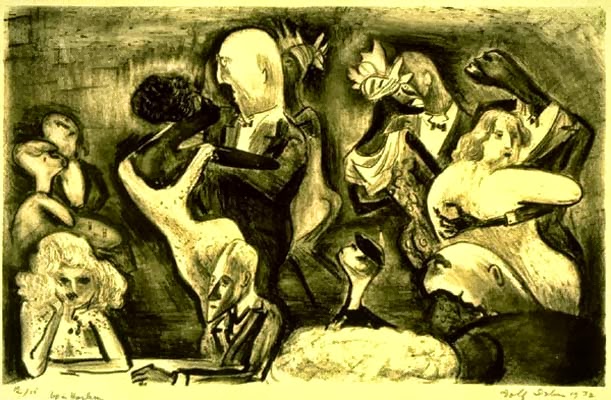
Adolph Dehn: The American Regionalist Gone Wild

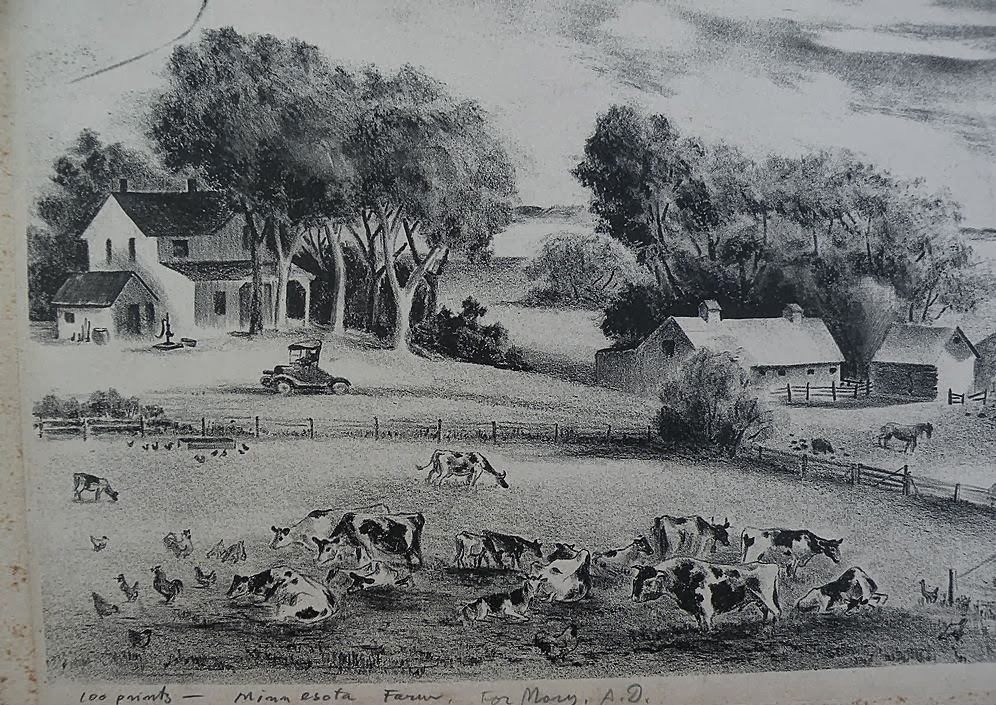
Noted American printmaker Adolf Dehn was a two-time recipient of the prestigious Guggenheim Fellowship, and he became one of the most important American printmakers of the 20th century. Throughout his artistic career, Dehn participated in the American Regionalism, Social Realism, and Caricature art movements. He began creating artwork at the age of six and by the time of his death, he had created an impressive body of over 600 prints! Imagine my surprise to find this very 'well-known' artist of the mid 20thc. - all but forgotten. Hopefully, this article will bring renewed interest in Dehn's work, and a new group of devotees. I, for one, am sold.


Biography
Dehn was born in Waterville, Minnesota, 1895 and died in New York City, 1968. His mother was a feminist, liberal, socialist member of the German Lutheran Evangelical Church and his father was an atheist and anarchist. Dehn went to the Minneapolis School of Art, then earned a scholarship to the Art Students League of New York. It would serve as a launching point for his career which would take him on travels around the globe and bring him fame and success.
In 1920 Dehn was introduced to printmaking by George Miller and Boardman Robinson. While in New York, Dehn threw himself into liberal politics.
After graduation, he was drafted to serve in World War I, but as a conscientious objector, Dehn refused to serve in the military and he was imprisoned for two years, spending four months in a boot camp in Spartanburg, SC, and eight months as a volunteer art instructor teacher at a hospital for war victims in Asheville, NC.

During the 1920s, after the war was over, Dehn spent eight years in Europe and got a reputation as a satirical printmaker. (In Paris, where he made lithographs at the Atelier Desjobert.) His subjects ranged from social satire to naturalistic landscapes. His cabaret, park scenes, burlesque and scenes of Europe's roaring 20's contrasted against his Midwest regional-looking landscapes, but he wisely used them as a means for selling when he established his own print club during the Great Depression. A number of his caricatures appeared in Vanity Fair.
It was in Paris that Dehn met his first wife, Mura Ziperovitch, a Russian dancer who had left the Soviet Union.In 1929 he and his wife returned to the New York, but the country's economic depression made their financial hardships too much to bear, and ultimately contributed to their divorce.
In the 1930s, Dehn's work began to appear in the New Yorker and Vogue. He earned a Guggenheim Fellowship in 1939, which allowed him to travel to the western United States and Mexico.
Dehn met his second wife, Virginia Engleman, (also an artist) when he participated with the American Artists Group, and they worked as artists for the rest of their lives. From 1938 to 1939 he taught at Stephens College in Columbia, MO. In 1940, he became a summer instructor at the Colorado Springs Fine Arts Center. taught printmaking to other American artists.
As he became more widely recognized and financially successful, Dehn traveled to Key West, Venezuela, Cuba, Haiti, Afghanistan, India and other countries.
Adolf Dehn is considered a prolific artist of great range. His works are found in over 100 museum permanent collections, including the Smithsonian Institute. Dehn’s breadth of work represents printmaking’s victory in the mid 20th century, and he was one of the most important artists in the American Regionalism/American Modernism movements. Thank goodness I found this man's work. I hope this brings some inspiration to others in their own artistic paths.

Exhibited
American Institute of Graphic Arts
American Printmakers Annual
Art Institute of Chicago
Boston Museum of Fine Arts
Cleveland Museum of Art
Knoedler Gallery
Minneapolis Institute of Art
Museum of Modern Art
National University, Mexico
New York Public Library
Newark Public Library
Salons of America
Society of American Painters, Sculptors and Gravers
Weyhe Gallery, NY
Whitney Museum of American Art, 1933-1962

Permanent Collections
Arizona State University Art Museum
Brooklyn Museum of Art
Buffalo Art Center, Cody, WY
Butler Institute of American Art
Colorado Springs Fine Arts Center
Cummer Museum of Art and Gardens, Jacksonville, FL
Denver Art Museum
Edwin Ulrich Museum of Art, Wichita State University, Wichita, KS
John and Mable Ringling Museum of Art, Sarasota, FL
Metropolitan Museum of Art
Michael C. Carlos Museum, Emory University, Atlanta, GA
Minneapolis Institute of Arts
Mount Olive College – Moye Library, Mount Olive, NC
Museum of Art at Brigham Young University
Museum of Modern Art
Nelson-Atkins Museum of Art, Kansas City, MO
Newark Museum
Norton Museum of Art, West Palm Beach, FL
Paine Art Center, Oshkosh, WI
Parrish Art Museum, Southampton, NY
Pennsylvania Academy of Fine Art
The Phillips Collection
Phoenix Art Museum
Robert Hull Fleming Museum, Burlington, VT
San Diego Museum of Art
Santa Barbara Museum of Art
Sheldon Swope Art Museum, Terre Haute, IN
Smithsonian American Art Museum
Southern Alleghenies Museum of Art, Loretto, PA
University of Arizona Museum of Art
University of Michigan Museum of Art
University of Minnesota
Whitney Museum of American Art
Woodstock Art Association, NY
Wright Museum of Art, Beloit, WI
*The Minnesota Historical Society and the Portland Museum of Art each have a complete collection of his prints.

Monday, October 7, 2013

Joscelyn Gardner Dares Explore the Secret Lives of 18thc. Creole Women

My fellow printmakers, you know there come some instances when you look at a person’s artwork and it either bores you, or it blows you out of the room. The latter is the case with the work of Caribbean artist Joscelyn Gardner. The discovery of this person’s powerful and thought-provoking work has been nothing less than a revelation and reinforces the idea that the printed image can communicate an informative message, but also transcend to a level of enlightenment.
On the tiny island of Barbados, from whence Gardner hales, this artist has sought some acknowledgement of her culture’s ancestry and ultimately has disclosed the darker side of women’s existence and survival in the 18th and 19th century when slavery and brutality against women were as common as drinking one’s afternoon tea.

A self-professed feminist, Gardner looks back at the women from this island’s past and recreates personages of African descent through iconic and symbolic representations of women’s braided hair, slave ‘collars’ (shackles and instruments of torture) and botanical plants indigenous to the island. That may seem a strange combination of symbols but they are intertwined into the consciousness of this culture and its descendants’ legacies. In her Bleeding & Breeding series, and her Creole Portraits III suite, Gardner exhibits a body of work which focuses on Creole women’s secret use of exotic tropical plants on 18th century Caribbean plantations to induce abortion, the iron slave ‘collars’ were used to punish women slaves when they conducted abortions.
Each image’s braided hair takes on a woven design and pattern. We see them from the back of the woman’s head as though it is laid out before us like a curious specimen on display. They hover above the circular collar devices; their prickly, metallic edges visible, and below these collars are plants, hanging downward. The plants are the only colored part of these prints. Gardner’s rendering of these images is tightly analytic. They look like botanical prints from a distance until you get closer and realize there are other components that carry the proverbial wallop.
In another project, White Skin, Black Kin, Gardner addresses the Caribbean’s history of varying shades of blackness and whiteness as their Creole ancestry has intermingled since the 18th c. She seeks to address the history of black and white Creole women’s lives from the time of the Great Plantations. She “re-creates” her own vision of the past to expose shared realities of Creole women and Caribbean culture.
These works are strong and speak to a period of time most would like to brush past, but Gardner, holds our attention, commands it, and expects us to confront it. Like the messy slavery heritage the 18thc .and 19thc. United States would like to ‘move forward and forget’, this work directly confronts our past and makes is deal with the seriousness of it, the pathos, albeit through cold, clinical analyzation. The scale of these prints are life-sized which also sends a slightly uncomfortable ‘twinge’ up the back of our spines. How this all could happen is not the point. It did happen, and we can’t ignore it any longer.
What is assured is that Gardner’s prints are sparking dialogue and discussions about women from this period and show that they were masters of their own domain, so to speak, in that they refused to be enslaved further to care for children that were a product of rape, or driving up the slave population, nor would they let their bodies be used as slave birthing machines. It was a difficult period, but it was also a period where women still made choices in the face of an existence with no visible freedoms. I applaud Gardner’s honesty in bringing these works to the world. We need more artists who have the guts and conviction to tell the truth. We need more artists like Joscelyn Gardner.
Bio:
Gardner is recognized internationally as a Caribbean artist.Born in Barbados in 1961 to a family that has been resident on the island since the 17thc., Gardner also spent time in South America and West Africa. She taught art at the Barbados Community College (1987-1999), founded and directed the Art Foundry galleries (1996-1999), and worked actively on many committees. She moved to Canada in 2000 and currently teaches in the School of Contemporary Media at Fanshawe College, London, Ontario.

Exhibitions:
Spain, USA, Canada, and the Caribbean. Europe and Latin America
22nd and 23rd Sao Paulo Biennials
XXXI Biennial de Pontevedra, Spain
Art Basel, Miami, FL
museums in France and Puerto Rico
Brooklyn Museum, New York
Canadian Impressions, Washington, DC
Harrington Art Center, Kolkata, India


Awards:
Grand Prize - 7th International Contemporary Printmaking Biennial, Trois-Rivieres, Quebec (2011)
PUMA Creative Mobility Award (2010)
Canada Council for the Arts international residency grant at Caribbean Contemporary Arts, Trinidad (2005)


Education:
MFA - University of Western Ontario
BFA (Printmaking) & BA (Film) - Queen’s University, Kingston, Ontario.

Permanent Collections:
Museum of Contemporary Art in Puerto Rico,
the Barbados National Gallery,
US Embassies Collection,
Museo TEOR/éTica in Costa Rica,
Fondacion Clemente in Dominican Republic,
and numerous corporate and private collections

Gardner’s work can be viewed at www.joscelyngardner.com

Tuesday, September 3, 2013

Atelier 17's Grand Master, Stanley William Hayter


You know there are printmakers, and then there are PRINTMAKERS. Stanley William Hayter is recognized as one of the greatest of the greats of this medium, and you'd be hard-pressed to find anyone who would refute it. His legacy for encouraging European and American artists, in fact artists from around the globe, who made their personal pilgrimages and flocked to his Atelier 17 doors, was and still is staggering. Artists who never had printed before suddenly were seen working in his studio. Notable artists of the 20th c. were commonly seen working on plates and inking it up alongside their colleagues. It was the Best place to work, and to study the Hayter 'multi-color technique'. He trained some of the best printmakers of the generation and his own work bridged between the standout Surrealism and Abstract Expressionism movements which defined the century.


Stanley William Hayter, CBE (1901 –1988) was a British artist associated in the 20thc with two of its most important art movements - Surrealism and Abstract Expressionism. Widely regarded as one of the most significant printmakers of the 20th century, in 1927 Hayter founded a print shop in Paris for young artists interested in the medium in 1927.The shop became known as Atelier 17, (which has since been called Atelier Contrepoint after his death in 1988).

Hayter was born in London’s Hackney neighborhood, to a family of artists. Before art became his passion, Hayter studied chemistry and geology from King's College London and worked in the Middle East from 1922-1925 for the Anglo-Persian Oil Company. When Hayter returned home to convalesce from an attack of malaria, he had a one-man show of the paintings and drawings he had made while overseas. Shortly thereafter, Hayter chose to study art.


In 1926, Hayter studied briefly at the Académie Julian in Paris. During that same year, he met a Polish printmaker Józef Hecht, who introduced him to the printmaking medium. Hecht helped Hayter acquire a press for starting a printmaking studio for artists young and old, experienced and inexperienced, to work together in exploring the engraving medium.In 1927, Hayter opened the studio, and in 1933 he moved it to No. 17, Rue Campagne-Première, where it became internationally known as Atelier 17.

In 1929 Hayter was introduced to Surrealism by Yves Tanguy and André Masson. He began a series of printmaking technical experiments all loosely based on the Surrealist/Jungian concepts of subconscious image and automatic line. At the outbreak of World War II, Hayter moved Atelier 17 to New York City and taught printmaking at the New School. Artists from around the world gathered to work with him, many had been part of the printmaking section of the WPA, and some young artists were interested in breaking with the past and experimenting with technique and ideas. The emphasis in New York focused more on experimental color printing, and technical experimentation. Artists such as Jackson Pollock and Mark Rothko made prints at the New York Atelier 17. Returning to Paris in 1950, Hayter took Atelier 17 with him. Hayter was a prolific printmaker, completing more than 400 before his death. His book New Ways of Gravure was published in 1949 and again in 1966, whereas his other book About Prints was published in 1962. Hayter made 452 prints during his lifetime.

Hayter returned to Paris in 1950 and re-established Atelier 17, attracting more international artists, including artists from Asia. Noted for his innovative work in the development of printing with varying viscosities of oil-based inks to lay multiple colors on a single intaglio plate). Hayter has been credited with influencing notable artists such as Pablo Picasso, Alberto Giacometti, Joan Miró, Alexander Calder, Marc Chagall, Jackson Pollock, Mark Rothko, and the great artist/teacher Mauricio Lasansky.

Awards
1951 - Officer (OBE) rank in the Order of the British Empire
1951 - The French government’s Légion d'honneur
1958 - Representative artist for Great Britain at the Venice Biennale
1967 - Chevalier des Arts et des Lettres of the Ordre des Arts et des Lettres
1968 - Commander (CBE) rank in the Order of the British Empire


The first family artist was Charles Hayter (1761-1828);a miniaturist and portrait draftsman as well as an artistic theoretician. He was appointed Princess Charlotte's Professor of Perspective and he published a treatise on this subject in 1813. Two of Charles Hayter's sons became well-known painters: Sir George Hayter (1792-1871) and John Hayter (1800-1891). George Hayter was appointed Queen Victoria's portrait and history painter on her accession to the throne. She knighted him in 1842 for his services. George's younger brother, John, first exhibited at the Royal Academy in 1815 at the age of 15. John Hayter was the great-great-grandfather of Stanley William Hayter. And S. W. Hayter's father, William Harry Hayter, was also a painter and professional artist.

Hayter was married three times: 1) Edith Fletcher (dissolved in 1929), 2) American sculptor Helen Phillips (dissolved in 1971), and 3) Irish poet and writer Desiree Moorhead, with whom he lived in Paris at the time of his death. He had three sons: Patrick from his first marriage, Augy and Julian from his second. Augy was an actor, writer and translator, and Julian was a composer, musician and photographer. All are deceased.


Stylistically, Hayter's often violent-looking Surrealist period was stimulated in part by his passionate response to the Spanish Civil War and to the rise of Fascism. His theoretical writings on automatism and the expressive abstraction of his own work were a formative influence on Pollock and others.
From the 1940s his primary technical preoccupation was with color printing. His technique suited an increasingly chance look and explored his fascination with waves. From the 1970's Hayter reintroduced figurative elements in combination with a vibrant palette and lyrical line. Like his work or not, one has to give the man kudos for inspiring and giving of his life for a medium he loved. We have all benefitted greatly from his work and the legacy that lives on in his workshop.


Monday, August 12, 2013

The Most Expensive Prints in the World...Really?

Well , my fellow inksters, some scouting around for examples of the top selling original prints at auction generated some varying reports, but I think I have grasped recent information to impart. You will pardon me for not knowing the very latest information, because I don't usually hang at the local art auction house. Being an artist myself, I'm likely to spend my cash on supplies than another work of art, and besides, it seems these auction things take place quite a lot so the information is always changing. :)

My quest to find the most expensive print in the world, lead me first to Pablo Picasso’s “Le Repas Frugal”, (pictured above) which was a bit of a surprise. I mean, really, this one is nice and all, but I guess I supposed that something by Rembrandt or Durer would claim the top prize. Still, there is something in this piece by Picasso that grabs the viewer. The primordial couple sitting very intimately at a table, looking out at the world, as if they hadn’t a care. The fact this piece comes early in Picasso’s oeuvre, lends some intrigue for the period the work is associated with – namely the carnival and Rose period. The couple’s faces are drawn and their gaze seems detached from the world around them. Their bodies are elongated as one would expect to see if El Greco was alive and working in the 20thc., but they aren’t representing celestial beings, just the average Parisian starving artist.
Then, after more investigation, I discovered there are subcategories to the original print auction records, and low and behold, some other surprising names and pieces popped up. I will give a listing and a sampling of them at the end of this article. More predictably, Rembrandt’s Three Crosses,” a 1653 etching, One impression,( about 80 are known to exist), sold privately a few years ago for $1.5 million. (It's estimable value in 1967 was a mere $20k. Yikes!) Albrecht Durer figures into the same subcategory with his famous "Adam and Eve" print.

Still, moving closer to our own time period, some of the most recent art auction sales for original prints on paper are garnishing staggering sums at auction. Pablo Picasso's “La Femme Qui Pleure I” (pictured here)now claims to the top price paid for a work of art on paper in the print category. A nice little piece, considering the subject is of a wailing woman:)

One Norwegian artist's print has recently risen to the upper levels of the charts and stolen our collective hearts. It's a quiet little color print by the tortured soul Edvard Munch. His "Young Woman on the Beach", done in 1891-92, just sold for a whopping $3.2 million.


Picasso's rival, Henri Matisse, rates the number Two spot for the Impressionist/Modern category with his “Océanie, La Mer”(below). It grandly reflects his latter Joy collage work, without the usual bold colors.
Two artists from the Contemporary category who have done well, one expectantly so, is Andy Warhol. His iconic Marilyn Monroe portrait is on the top-selling list, but it's his Chairman 'Mao" 10 portraits series that has garnished over $2 million in recent sales. They seemed a sort of quirky subject, given Mao wasn't the Iconic American figure like Marilyn was, but in the 1970s, when US President Nixon went to visit the famed leader of the eastern world, it was big news and a significant step toward what became global enterprise.


For a living artist, Jasper Johns has realized a hefty price for one of his prints, "Untitled" from 1983, where this painterly impression brought in $1.5 million in 2012.It's not exactly a favorite of mine, but it easily speaks to John's paintings.

All this fuss about some dried ink on paper, but admit it, they Are treasures in the art world, and they reflect a growing art-savvy collector base. We printmakers can take encouragement from this news, as we all know we’re not giving up the 'ink in our veins idea' that original prints are worth as much as any old bit of oil paint on canvas, or a collage, or even a .... photograph.

Truly, the real thing here to pay attention to is not how Much $ these lovely pieces of paper are Worth. The real importance to any of them is the artist who decided to make an image friom his/her imaginaiton or observations. The real importance is the result we get from seeing these images and the messages they convey to our collective souls. No one auction record could ever mean anything compared to that.

Look over these stats, and chew on those numbers. Just imagine how much paper, plates and ink we could buy with that, eh?

OLD MASTERS
1. Rembrandt van Rijn, “Christ crucified between the two thieves: The Three Crosses” (circa 1660) $990,000 at Doyle New York, May 23, 1990.
2. Rembrandt van Rijn, “Christ Presented to the People: Oblong Plate” (1655)
$956,100 at Christie’s London, December 10, 1991.
3. Rembrandt van Rijn, “Christ Crucified Between the Two Thieves: The Three Crosses” (1653–61) $924,200 at Christie’s London December 5, 2006.
4. Albrecht Durer, “Adam and Eve” (1504) $655,900 at Christie’s London, July 7, 2011.
5. Albrecht Durer, “Map of the Northern Sky and Map of the Southern Sky” (circa 1515)
$577,800

IMPRESSIONIST/MODERN
1. Pablo Picasso, “La Femme Qui Pleure I” (1937) $5,122,500 at Christie’s New York, November 1, 2011.
2. Henri Matisse, “Océanie, La Mer” (1946–47) $4,774,500 at Christie’s London, June 21, 2011.
3. Pablo Picasso, “Le Repas Frugal” (1904) $3,052,400 at Christie’s London, June 20, 2012.
4. Edvard Munch, “Vampire II” (1895–1902)$2,182,800 at Grev Wedels Plass Auksjoner, Oslo, November 27, 2007.
5. Pablo Picasso, “La Minotauromachie” (1935) $1,980,400

CONTEMPORARY
1. Andy Warhol, “Mao” (set of 10 from 1972) $2,544,800 at Sotheby’s London, May 22, 2012.
2. Andy Warhol, “Mao” (set of 10 from 1972) $1,684,900 at Christie’s London, October 16, 2007.
3. Andy Warhol, “Marilyn Monroe” (set of 10 from 1967) $1,551,800 at Christie’s London, June 20, 2007.
4. Jasper Johns, “Untitled” (1983) $1,482,500 at Christie’s, New York, May 9, 2012.
5. Andy Warhol, “Mao” (set of 10 from 1972) $938,500.