I do love the ability of a print to grab one's attention, open one's eyes to events in the world and bring about some acknowledgement and change. Such is the work of Arturo Garcia Bustos. His dramatic and no nonsense works sear right into our hearts and let us see, as only one from inside a situation can, the depths of humanity and the trials of a burdened nation trying to free itself from under the slumbering giant keeping them subjugated. Garcia Bustos' prints speak to us today as eloquently as from the time of the Mexican Muralist period when these images were made. He talks about the noble, poor working classes, and poverty and their struggle to be an independent people. He talks about the injustices found in the Mexican government who, at the time, sought to keep literal and artistic voices silent through intimidation and pain from death squads (not unlike today's corrupted situation). Some of his work references other themes like the "Sower" straight out of Millet and van Gogh; planting the seeds of revolution. Other times we see, like one of the prints shown below, the ghost of Goya's "3rd of May" painting, where the innocent are systematically slaughtered. There is little of Garcia Bustos' work that isn't well-considered and measured in his graphic voice. The work is bold and bows down to no one. He is considered one of Mexico's greatest living printmakers and muralists. His devotion to teaching is unparalleled in a land where mentorship is keenly felt and continues to feed Mexico's strong artistic legacy. He is an inspiration to generations of printmakers here and abroad.
Arturo García Bustos was born in Mexico City in 1926. As a child, Garcia Bustos was drawn to art with the wave of Mexican Muralism sweeping the nation. He studied architecture at the Escuela Nacional Preparatoria Núm 1 and then, at the age of fifteen, he went to study at the Escuela Nacional de Artes Plásticas in 1941, UNAM, INBA and later at the Escuela de Pintura y Escultura ("La Esmeralada")
One of his teachers was Frida Kahlo, with whom he went to study at her home in Coyoacan when she became too ill to go to the school. She affectionately called that group of students “Los Fridos”. He also worked as a mural painting apprentice with Diego Rivera. In the 1950s, Garcia Bustos took his first printmaking courses with Leopoldo Méndez at the Taller de Gráfica Popular, and then went to Korea and China to study Asian printmaking techniques.
Much of his career has been spent teaching and giving lectures, seminars and conferences. He taught engraving at the Escuela de Bellas Artes in Guatemala City and founded the Taller de Grabado at the Casa del Lago in Chapultepec. He taught fine arts at the Escuela de Bellas Artes of the Benito Juárez Autonomous University of Oaxaca, Escuela de Iniciación Artística Núm. 3 in Mexico City and drawing and painting workshops at the Casa del Lago in Chapultepec. He has given conferences on the history of engraving and lithography in Mexico at the state universities of Oaxaca and Sinaloa, the Galería Municipal de Veracruz and in various venues in Mexico City. Abroad, he has given conferences on Mexican muralism and engraving in Germany, Italy and Guatemala.
García Bustos’ social life was spent in the company of Diego Rivera and Frida Kahlo, sharing their ideas on art and politics. It was there he met and married his future wife, Guatemalan artist Rina Lazo. Garcia Bustos and his wife curently live in Mexico City and have opened part of their house, calling it the Galería de la Casa Colorado. The couple’s daughter, Rina García Lazo, an architect specializing in monument restoration, runs the gallery.
He has had numerous exhibitions in Argentina, Bolivia, Ecuador, Germany, Guatemala, El Salvador, Mexico, North Korea, the Soviet Union, , the United States, Venezuela, and he participated in numerous exhibitions with the Taller de Gráfica Popular.
Murals:
1947 assisted Frida Kahlo with a mural at the Josefa Ortiz de Domínguez House, Coyoacán
1948 Hotel Posada del Sol, Mexico City
1950 Escuela Rural de Temixco, Morelos
1952 Sociedad Cooperativa Ejidal, with Rina Lazo and Atilio Carrasco
1964 Pobledores de las Siete Regiones de Oaxaca, Museo Nacional de Antropología
1969 sixteen print murals, Venustiano Carranza House Museum in Cuatro Ciénegas, Coahuila
1971 Casa de Obrero Mundial, Mexico City
Oaxaca en la historía de México, state government building, Oaxaca
Centro de la Cultura, Azcapotzalco, Mexico City
Accolades:
1947 first prize, UNAM
1949 second prize, poster contest honoring Chopin
1953 gold medal, Peace Movement, Guatemala
1954 first prize Grupo Saker-Ti, Guatemala
1955 first prize and gold medal , V Festival de la Juventud, Poland
1957 first prize, Salón Annual de Grabado, Salón de la Plástica Mexicana
1957 silver medal, engraving event, Moscow
1962 first prize, Consejo Nacional de Turismo, Mexico City
1973 member of the Academia de Artes
1974 member of the World Peace Council
1974 Salón de la Plástica Mexicana
1974 Mexican Academy of Arts
A place for talking about art, social issues, and most anything else I think THAT'S INKED UP.
Wednesday, February 19, 2014
Sunday, February 16, 2014
Scratched Up and Raw: The Print World of Max Beckmann
Max Beckmann (1884 –1950) was a German artist most known for his expressive style in both painting and printmaking. He rejected association with the German Expressionists in favor of the New Objectivity (Neue Sachlichkeit), which was a movement deviating away from the deeply emotional aspects of Expressionism. What has always drawn me to Beckmann's print work is his passionate and raw line. His scratched, even ugly, lines are often counter-weighted against a delicate, almost tracery web which weaves his images together. There is intimacy between his lovers/characters, and then in a flip of reality we see his own deeply disturbed pain searing through us through his self-portrait series.
Max Beckmann was born into a middle-class family in Leipzig, Saxony, during the German Empire. He enrolled at the Weimar Academy of Arts in 1899 and, between 1903 and 1904, traveled to Paris, Geneva, and Florence. During WWI, Beckmann volunteered to work as a medical orderly. He served in Belgium, where he met fellow artist Erich Heckel. He was discharged in 1915 after suffering a nervous breakdown. In 1925 he was appointed professor to teach a master class at the Städelschule Academy of Fine Art in Frankfurt.
The successes of Beckmann’s early career changed once Adolf Hitler came into power. In 1933, the Nazi government labelled Beckmann a "cultural Bolshevik" and dismissed him from his teaching position in Frankfurt. In 1937 more than 500 of his works were confiscated from German museums, and several pieces were included in the now infamous Degenerate Art exhibition in Munich. That same year, Beckmann took his wife, left Germany, and lived a ten year self-imposed exile in Amsterdam.
After the war, Beckmann and his wife moved to the United States, and he taught art at Washington University in St. Louis. Beckmann then taught at the University of Colorado, Boulder, during the summer of 1949 and the following fall at the Brooklyn Museum Art School. He and his wife later moved to New York City where he died of a heart attack in 1950.
The trauma Beckmann experienced in the war moved his artwork away from most classical interpretations of the human figure to something distorted and fractured. His compositions became angled, broken and chaotic. There was no space to breathe or room to maneuver within. Ultimately, this scratched up distortion affected his view of himself, which can be easily seen in his featherly, yet raw-looking self-portraits.
Unlike several of his avant-garde contemporaries, Beckmann took up and advanced the tradition of figurative painting in a deeply personal form of modernism. He greatly admired the artwork of Cézanne, Van Gogh, Rembrandt, Bosch, Bruegel and Grünewald. His composition style is also rooted in the tradition of medieval stained glass, the early renaissance idea of the triptych and he expanded them to include contemporary events.
Beckmann saw the world as a tragedy of man's inhumanity to man, and he saw life as a carnival of human folly. His work remained intense and allegorical throughout his career, but after the mid-1920s his style of painting changed to include Expressionistic brushwork and brighter colors. Some of his imagery refers to the decadent glamor of the Weimar Republic's cabaret culture, but from the 1930s on, his works often contain mythologized references to the brutalities of the Nazis. His subjects and symbols expressed universal themes of terror, redemption, and the mysteries of eternity and fate.
As for his printmaking, Beckmann made a total of 373 prints, all black and white, most of them produced between 1914 and 1923. He preferred etching and drypoint, but also worked in lithography; and he made woodcuts. Most of his prints were issued by leading dealer-publishers, including Paul Cassirer and J. B. Neumann, in Berlin, and Reinhard Piper, in Munich, although in 1921 Beckmann signed an exclusive contract with J. B. Neumann.
Like some of his art colleagues, Beckmann’s work falls within art movements, never clearly embracing one over another, so he, like the artists Oscar Kokoshka and Frida Kahlo, remain unique and outside normal categorization.
Lastly, the Parisian novelist and art historian, Stephan Reimertz, published Max Beckmann’s biography Eine Liebe im Porträt. Minna Tube - Künstlerin im Schatten von Max Beckmann,
Publ: Rowohlt Tb. 2002
Awards & Major exhibitions:
1912 First solo show, Kunstverein, Magdeburg, and Grossherzogliches Museum für Kunst und Kunstgewerbe, Weimar
1926 First show in the United States, J. B. Neumann’s New Art Circle, New York
1927 Honorary Empire Prize for German Art and the Gold Medal of the City of Düsseldorf
1928 Städtische Kunsthalle, Mannheim
1930 exhibitions in Basle and Zurich
1938 First of numerous exhibitions at Curt Valentin’s Buchholz Gallery, New York
1948 First retrospective in the United States, the City Art Museum, Saint Louis
1949 First prize in the exhibition Painting in the United States, the Carnegie Institute, Pittsburgh
1964-65 Museum of Modern Art, Boston Museum of Fine Arts, Art Institute of Chicago
1984 Nassau County suburban art museum, NY
1995 Museum of Modern Art
1996 Guggenheim Museum
1996 Rome and Valencia
1997 Madrid
1998 Zurich
1998 St. Louis
2000 Munich
2006 Frankfurt
2007 Amsterdam
2002 Centre Pompidou, Paris
2003 Tate Modern
2011 Städel,Frankfurt
Max Beckmann was born into a middle-class family in Leipzig, Saxony, during the German Empire. He enrolled at the Weimar Academy of Arts in 1899 and, between 1903 and 1904, traveled to Paris, Geneva, and Florence. During WWI, Beckmann volunteered to work as a medical orderly. He served in Belgium, where he met fellow artist Erich Heckel. He was discharged in 1915 after suffering a nervous breakdown. In 1925 he was appointed professor to teach a master class at the Städelschule Academy of Fine Art in Frankfurt.
The successes of Beckmann’s early career changed once Adolf Hitler came into power. In 1933, the Nazi government labelled Beckmann a "cultural Bolshevik" and dismissed him from his teaching position in Frankfurt. In 1937 more than 500 of his works were confiscated from German museums, and several pieces were included in the now infamous Degenerate Art exhibition in Munich. That same year, Beckmann took his wife, left Germany, and lived a ten year self-imposed exile in Amsterdam.
After the war, Beckmann and his wife moved to the United States, and he taught art at Washington University in St. Louis. Beckmann then taught at the University of Colorado, Boulder, during the summer of 1949 and the following fall at the Brooklyn Museum Art School. He and his wife later moved to New York City where he died of a heart attack in 1950.
The trauma Beckmann experienced in the war moved his artwork away from most classical interpretations of the human figure to something distorted and fractured. His compositions became angled, broken and chaotic. There was no space to breathe or room to maneuver within. Ultimately, this scratched up distortion affected his view of himself, which can be easily seen in his featherly, yet raw-looking self-portraits.
Unlike several of his avant-garde contemporaries, Beckmann took up and advanced the tradition of figurative painting in a deeply personal form of modernism. He greatly admired the artwork of Cézanne, Van Gogh, Rembrandt, Bosch, Bruegel and Grünewald. His composition style is also rooted in the tradition of medieval stained glass, the early renaissance idea of the triptych and he expanded them to include contemporary events.
Beckmann saw the world as a tragedy of man's inhumanity to man, and he saw life as a carnival of human folly. His work remained intense and allegorical throughout his career, but after the mid-1920s his style of painting changed to include Expressionistic brushwork and brighter colors. Some of his imagery refers to the decadent glamor of the Weimar Republic's cabaret culture, but from the 1930s on, his works often contain mythologized references to the brutalities of the Nazis. His subjects and symbols expressed universal themes of terror, redemption, and the mysteries of eternity and fate.
As for his printmaking, Beckmann made a total of 373 prints, all black and white, most of them produced between 1914 and 1923. He preferred etching and drypoint, but also worked in lithography; and he made woodcuts. Most of his prints were issued by leading dealer-publishers, including Paul Cassirer and J. B. Neumann, in Berlin, and Reinhard Piper, in Munich, although in 1921 Beckmann signed an exclusive contract with J. B. Neumann.
Like some of his art colleagues, Beckmann’s work falls within art movements, never clearly embracing one over another, so he, like the artists Oscar Kokoshka and Frida Kahlo, remain unique and outside normal categorization.
Lastly, the Parisian novelist and art historian, Stephan Reimertz, published Max Beckmann’s biography Eine Liebe im Porträt. Minna Tube - Künstlerin im Schatten von Max Beckmann,
Publ: Rowohlt Tb. 2002
Awards & Major exhibitions:
1912 First solo show, Kunstverein, Magdeburg, and Grossherzogliches Museum für Kunst und Kunstgewerbe, Weimar
1926 First show in the United States, J. B. Neumann’s New Art Circle, New York
1927 Honorary Empire Prize for German Art and the Gold Medal of the City of Düsseldorf
1928 Städtische Kunsthalle, Mannheim
1930 exhibitions in Basle and Zurich
1938 First of numerous exhibitions at Curt Valentin’s Buchholz Gallery, New York
1948 First retrospective in the United States, the City Art Museum, Saint Louis
1949 First prize in the exhibition Painting in the United States, the Carnegie Institute, Pittsburgh
1964-65 Museum of Modern Art, Boston Museum of Fine Arts, Art Institute of Chicago
1984 Nassau County suburban art museum, NY
1995 Museum of Modern Art
1996 Guggenheim Museum
1996 Rome and Valencia
1997 Madrid
1998 Zurich
1998 St. Louis
2000 Munich
2006 Frankfurt
2007 Amsterdam
2002 Centre Pompidou, Paris
2003 Tate Modern
2011 Städel,Frankfurt
Sunday, February 9, 2014
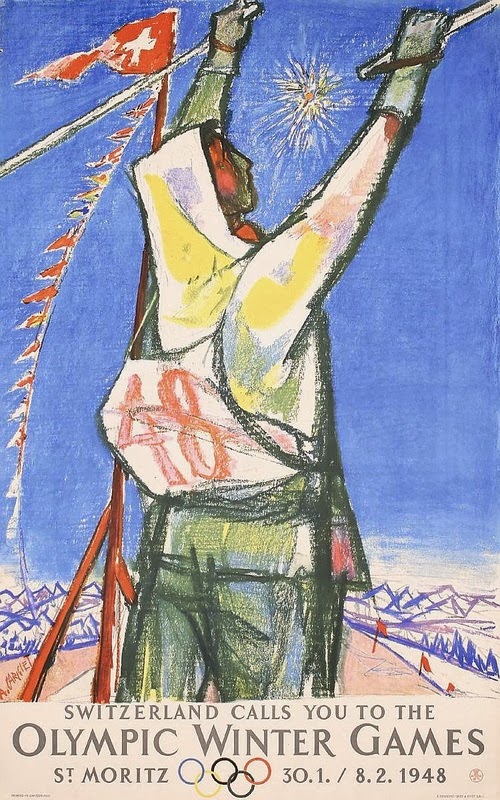
Printmakers do the Olympics!
Yes, our printmaker legacy continues not only for political elections and holidays, but we have participated in the Olympics as well. This random selection of vintage and contemporary prints, commemorating the great achievements in global athletic competition, show an elegance, grace, speed and sheer will and determination to being the best - with a few abstract compositions thrown in for good measure. We have a lot to be proud of, showing the world this time honored printmaking form, and enjoying the fruits and toils of our athletes' labors. You will pardon my patriotism if I say Go Team USA!
Labels:
bobsled,
Olympics,
pairs ice-skating,
skiing,
Sochi,
speed-skating,
Team USA,
winter Olympic prints
Sunday, February 2, 2014
Suleyman Tekan: Romancing Turkish Printmaking
As I have been on the search for printmakers, Süleyman Saim Tekcan popped into my radar. I was immediately taken with the physical quality of his work, the deeply etched surfaces, how calligraphy is intertwined with his images, and, of course, his use of color. They make for some very pleasing surfaces and make me wish I could read the calligraphy often found in his prints. These images are irregular, rough-edged, not the standard printmaker format. The fragmented-ness of them leads me to think of them from an eastern (Asian painting) perspective where the viewer sees only that part of a composition that the artist chooses to be made visible. We know there is more beyond the edges of the print, and we look forward to seeing the next plate to see if we can pick up the story in the next image. Tekcan's color is that lovely mixture of multiple printing and it revolves around his obvious love of horses. Horses to persons of the Middle east and Central Asia are symbolic of strength, speed and nobility. Tekcan's horses are more arabesque and linear than photographically rendered. They are a romantic illusion of the beautiful animal, crossing some mythic plane. The horses are surrounded by calligraphic text which when placed next to the steeds are an extension of the horse in motion. This symbol has been a part of art-making for centuries, from the time of the ancient Greeks, military leaders like Alexander the Great, the equestrian portraits of the Roman emperors, English kings and French Napoleonic despots. The Arabian horses have been so intrinsically valued in the Middle east. Their beauty and sensitivity, intelligence and class of breeding is still highly prized. Who could not love those horses in the chariot races of the film classic "Ben Hur"?But, I digress....
Süleyman Saim Tekcan was born in 1940, on the southeastern edge of the Black Sea, in Trabzon, Turkey. He studied painting at the Ankara Gazi Education Institute and at the Istanbul State Academy of Fine Arts (Miamr Sinan University). In 1968, he became a teacher at Ataturk Education, and then in 1975 he went to teach art at Mimar Sinan University. Tekcan served as Chair of the Graphic Arts department and later became Dean of the Arts Program in 1994-1995. The next year, he went to become Dean of the Arts program at Yeditepe University and in 2007, he went to Isik University to serve as Dean of their faculty.
Tekcan has also conducted research on printmaking techniques in Germany and Sarajevo. He has also established the following printmaking studios:
Istanbul Atatürk Education Faculty’s Printmaking Studios
Istanbul Technical University’s Printmaking Studios
Istanbul State Academy of Fine Arts Printmaking Studios
Çamlıca Original Printmaking Studio
Awards
2007 Königswinter City Artist Award
2006 Istanbul Rotary Club, 2005-2006 Profession Rewards
2006 Asia Prize, Marmara University, IMOGA, for the Foundation of Istanbul Museum of Graphic Arts
1993 Art Institution Artist of the Year Prize
1992 State Original Printmaking Exhibition Second Prize
1988 49th State Painting and Sculpture Exhibition Printmaking Third Prize
1986 Turkey Asia-Europe Biennial Prime Ministry Friendship and Peace Prize Silver Medal in Printmaking
1986 Bangladesh Asian Biennial Original Print Grand Prize
1985 Viking Paper Industries Printmaking Comp. Achievement Prize
1982 State Painting and Sculpture Museums Present Day Artists Print Prize
Tekan’s work has been included in numerous exhibitions in Austria, Belgium, China, England, Germany, Italy, Japan, Norway, Turkey, the United States and Yugoslavia.
Web Site www.suleymansaimtekcan.com Email: sstekcan@imoga.org
In 2006, one of Tekcan's major achievements was to co-found the Istanbul Museum of Graphic Arts. It is a place for exhibitions of local and international printmakers. For more information, please contact them at:
Address:Ünalan Mahallesi Keban Cad. No:20 Üsküdar 34700 İstanbul Turkey
Phone: 216-470 9292 Web: www.imoga.org
Süleyman Saim Tekcan was born in 1940, on the southeastern edge of the Black Sea, in Trabzon, Turkey. He studied painting at the Ankara Gazi Education Institute and at the Istanbul State Academy of Fine Arts (Miamr Sinan University). In 1968, he became a teacher at Ataturk Education, and then in 1975 he went to teach art at Mimar Sinan University. Tekcan served as Chair of the Graphic Arts department and later became Dean of the Arts Program in 1994-1995. The next year, he went to become Dean of the Arts program at Yeditepe University and in 2007, he went to Isik University to serve as Dean of their faculty.
Tekcan has also conducted research on printmaking techniques in Germany and Sarajevo. He has also established the following printmaking studios:
Istanbul Atatürk Education Faculty’s Printmaking Studios
Istanbul Technical University’s Printmaking Studios
Istanbul State Academy of Fine Arts Printmaking Studios
Çamlıca Original Printmaking Studio
Awards
2007 Königswinter City Artist Award
2006 Istanbul Rotary Club, 2005-2006 Profession Rewards
2006 Asia Prize, Marmara University, IMOGA, for the Foundation of Istanbul Museum of Graphic Arts
1993 Art Institution Artist of the Year Prize
1992 State Original Printmaking Exhibition Second Prize
1988 49th State Painting and Sculpture Exhibition Printmaking Third Prize
1986 Turkey Asia-Europe Biennial Prime Ministry Friendship and Peace Prize Silver Medal in Printmaking
1986 Bangladesh Asian Biennial Original Print Grand Prize
1985 Viking Paper Industries Printmaking Comp. Achievement Prize
1982 State Painting and Sculpture Museums Present Day Artists Print Prize
Tekan’s work has been included in numerous exhibitions in Austria, Belgium, China, England, Germany, Italy, Japan, Norway, Turkey, the United States and Yugoslavia.
Web Site www.suleymansaimtekcan.com Email: sstekcan@imoga.org
In 2006, one of Tekcan's major achievements was to co-found the Istanbul Museum of Graphic Arts. It is a place for exhibitions of local and international printmakers. For more information, please contact them at:
Address:Ünalan Mahallesi Keban Cad. No:20 Üsküdar 34700 İstanbul Turkey
Phone: 216-470 9292 Web: www.imoga.org
Monday, January 13, 2014
The Surreal Netherworld of Victor Manuel Hernandez Castillo
Mexico's love affair with printmaking goes way back to the time of the Spanish Colonial invasion. Prints produced at that time were mostly brought to the New Spain, via the Church, describing pictures of saints, stories from the Bible. Some printed images came by way of maps, describing the newly appropriated Viceregal territories; or for the curious and scientific-minded, anthropological prints identifying the physical attributes of the New World's 'human species' had a huge European audience for those people looking to find a new life in the Meso-American'colonies'.
The printing process was introduced to the indigenous working class, and it, like architecture and decorative arts of the period, began to thrive. Prints to illustrate books and the movable printing letters produced an army of small papers and presses. Print shops that produced lithographs and relief prints grew as the country's war for independence came about. Those printmakers commented upon the state of affairs and societal customs and superstitions. Approaching the 20th century, printmaking in Mexico took a decided political turn, and printmakers like Jose Guadalupe Posada helped to fuel movements for the rights of the working classes and promote political agendas.
I have been fascinated with the brutal honesty one can find in Mexican or Latin American prints. Many artists have made images, knowing full well it would cause upheaval, and sometimes at great personal sacrifice. The flip side of Mexican printmaking is that which relates to literature and the surrealism one finds rampantly running the streets of this huge, wonderfully chaotic and exotic country. Complex images filled with what one can physically see, are sprinkled with one cannot possibly understand, yet magically it seems perfectly normal. Anyone who has read the works of Gabriel Garcia Marquez or Luis Alberto Urrea understands this concept well.
One contemporary Mexican printmaker whose works describe the more surreal side of life is Victor Manuel Hernandez Castillo. Castillo's work is initially something out of a acid-trip dream. There are monsters and ghoulish faces, strange planes with human heads and arms attached to spoked-wheels. People, using the term liberally, fly through his compositions as though in a Chagall-inspired dream, but they seem more appropriately linked to the current culture's vampire-laced fantasies of creatures out for an evening's feast. In any event, Castillo fills his compositions with loads of fun and creep. Castillo gives us ghoulish kids riding their bicycles like banshees to a place no one wants to ponder, horrific gargoyle-like creatures out of the movie "Ghost-busters" travel moonlit landscapes in search of their prey,and depraved bird-bats fly overhead in search of new victims.
The netherworld Castillo presents to us is attractively repulsive. As much as we look, there is more to see buried within other images. His compositions are chock-full of creatures where we spend maybe more time than we want trying to figure out what they are. And for what it's worth, its all completely in bounds as far as Mexican surrealism goes. These netherworld creatures could stand for persons in our visible world, or stand as symbols for the corruption-laden operators who have plagued Mexico for years. I can't speak for Castillo's intentions. I can only describe what the images portend. Even a seemingly simple family portrait image with ancestors framed on a wall behind the primordial family unit has undertones of those whose family members weren't maybe so pleasant.
This work has teeth, and it bites into what rests slightly below the skin of this country, describes an undertone of fear and unrest among Mexico's sleeping giant population. If his images were truly to come to the surface, to the conscience of the people, some would go mad, some would cry out in pain, and some would go back to sleep because it would be preferable to think it was all a bad dream than see it as reality. Castillo places these images in our faces, and puts a slightly quirky and unreal twist on them to make us think they are surreal or humorous, when in fact they tell the truth. Looking at them we can see the clever disguises he puts in the images, but they get under our skin and fester like boils. Rising to the surface, these boils will burst and bring out the ugliness that one's conscious mind would choose to bury. These images cannot be ignored, nor can they be forgotten.
Education: Escuela Nacional de Artes Plasticas UNAM, Mexico City, Mexico
The printing process was introduced to the indigenous working class, and it, like architecture and decorative arts of the period, began to thrive. Prints to illustrate books and the movable printing letters produced an army of small papers and presses. Print shops that produced lithographs and relief prints grew as the country's war for independence came about. Those printmakers commented upon the state of affairs and societal customs and superstitions. Approaching the 20th century, printmaking in Mexico took a decided political turn, and printmakers like Jose Guadalupe Posada helped to fuel movements for the rights of the working classes and promote political agendas.
I have been fascinated with the brutal honesty one can find in Mexican or Latin American prints. Many artists have made images, knowing full well it would cause upheaval, and sometimes at great personal sacrifice. The flip side of Mexican printmaking is that which relates to literature and the surrealism one finds rampantly running the streets of this huge, wonderfully chaotic and exotic country. Complex images filled with what one can physically see, are sprinkled with one cannot possibly understand, yet magically it seems perfectly normal. Anyone who has read the works of Gabriel Garcia Marquez or Luis Alberto Urrea understands this concept well.
One contemporary Mexican printmaker whose works describe the more surreal side of life is Victor Manuel Hernandez Castillo. Castillo's work is initially something out of a acid-trip dream. There are monsters and ghoulish faces, strange planes with human heads and arms attached to spoked-wheels. People, using the term liberally, fly through his compositions as though in a Chagall-inspired dream, but they seem more appropriately linked to the current culture's vampire-laced fantasies of creatures out for an evening's feast. In any event, Castillo fills his compositions with loads of fun and creep. Castillo gives us ghoulish kids riding their bicycles like banshees to a place no one wants to ponder, horrific gargoyle-like creatures out of the movie "Ghost-busters" travel moonlit landscapes in search of their prey,and depraved bird-bats fly overhead in search of new victims.
The netherworld Castillo presents to us is attractively repulsive. As much as we look, there is more to see buried within other images. His compositions are chock-full of creatures where we spend maybe more time than we want trying to figure out what they are. And for what it's worth, its all completely in bounds as far as Mexican surrealism goes. These netherworld creatures could stand for persons in our visible world, or stand as symbols for the corruption-laden operators who have plagued Mexico for years. I can't speak for Castillo's intentions. I can only describe what the images portend. Even a seemingly simple family portrait image with ancestors framed on a wall behind the primordial family unit has undertones of those whose family members weren't maybe so pleasant.
This work has teeth, and it bites into what rests slightly below the skin of this country, describes an undertone of fear and unrest among Mexico's sleeping giant population. If his images were truly to come to the surface, to the conscience of the people, some would go mad, some would cry out in pain, and some would go back to sleep because it would be preferable to think it was all a bad dream than see it as reality. Castillo places these images in our faces, and puts a slightly quirky and unreal twist on them to make us think they are surreal or humorous, when in fact they tell the truth. Looking at them we can see the clever disguises he puts in the images, but they get under our skin and fester like boils. Rising to the surface, these boils will burst and bring out the ugliness that one's conscious mind would choose to bury. These images cannot be ignored, nor can they be forgotten.
Education: Escuela Nacional de Artes Plasticas UNAM, Mexico City, Mexico
Subscribe to:
Posts (Atom)


.jpg)