Friday, June 3, 2016

Ouida Touchon's Fascination with the Natural World

Ouida Touchon lives and works in the little town of Mesilla, New Mexico. Touchon studied art in Dallas, Texas, and in Kansas City, Missouri, before heading to New Mexico where she teaches at Dona Community College in Las Cruces, New Mexico. Her world is filled with birds, flowers and the beauty of Nature.
Touchon's use of the print medium isn't just a straight cut of the block and print onto plain paper. She chooses to embellish her images with pre-printed paper, further complicating and mixing up the textures of her prints.
The organic lines and multiple-layered images reflect her world view, oddly in opposition to her so-called spartan existence living in a virtual southwestern desert climate. One would not expect to see the clamour of color she infuses into her prints, but we are delighted with her bold color mixed with soft, delicate tones. We can hear her morning birds calling their mates among the flowering trees.


Touchon gives us a taste of the sweetness found in the southwest, and invites us to explore the hidden treasures of her environment. We could all do well to explore a place unknown to us, to enrich our creative souls, and nurture our artistic inspirations.

Education
M.A. University of Missouri - Kansas City, MO
B.F.A. Kansas City Art Institute, Kansas City, MO
A.A. El Centro College, Dallas, TX
Workshops
South Dakota, Scotland, England, Italy

Public Collections
Dona Ana Community College, Las Cruces, NM
El Paso Museum of Art, El Paso, TX
Federal Building of Las Cruces, NM
Taylor-Barela-Reynolds-Mesilla State Monument , Mesilla, NM

Memberships
American Print Alliance
California Society of Printmakers
Dona Ana Arts Council
Los Angeles Print Society
National Museum of Women in the Arts
Southern Graphics Council

Wednesday, May 25, 2016

Tanigami Konan's Botanical Prints for Spring

In thinking about all things spring, I came upon the botanical prints of Tanigami Konan of Japan. His floral prints drew my attention immediately for their brilliant rich color and simplicity of composition. The thing is, though, they did not remind me of any botanical print I have ever seen before. There is something non-Asian about them. The compositions feel more influenced by western ideals than Asian, and in fact, they are.
The work is wonderfully simple in execution and as we might find in Asian works, there is little or nothing to distract us from the subject. The subject is all there is to see, and as a viewer, we cannot want for more. What is portrayed is perfect. Konan’s delicate lines and carefully composed blooms lets the viewer smell them and imagine walking amongst them in a garden of our own making.

Admirers and collectors of traditional botanical prints will find them refreshingly pungent in color, less concerned with scientific detail, although they are quite accurately described. The issue here is not to separate the viewer from the image- to analyze it – but to immerse the viewer with the subject. Konan succeeds in this goal superbly.

Tanigami Konan was born 1879 in Hyogo, Japan. He was a well-known artist of the Kacho-e Nihon-ga (birds and flowers) tradition, and he was the first Japanese artist to portray Western flowers. Konan produced five portfolios of prints called 'Seiyo Soka Zofu', (A Picture Album of Western Plants and Flowers), which were published in 1917/18. They were organized as a visual record of flowers, depicting them in full bloom. Four portfolios were devoted to the spring and summer flowers, and the last portfolio combined autumn/winter flowers and plants.
These prints display the very best flowers - tulips, lilies, daffodils, crocus, and iris of the botanical world. Their appeal was driven by the compositionally fuller style of the West versus the East’s more restrained version.

Konan is especially known for his peony series. (Peonies are one of my favorite flowers.) He was selected to create a series of twenty-four prints for the Teiten (Imperial Exhibition of 1917).
These prints were printed in a large format. Their bold, bright colors are stunning, and they are considered some of the finest floral images ever printed.
The choice to publish these prints was done at a very interesting time in Japan’s printmaking history; when older, traditional ways of printing were yielding to new western technologies.
Artists and printers in Japan were losing their living due to these modern developments, so they chose to pursue subjects that would appeal to Western collectors. Heavily influenced by the French Impressionist movement, they incorporated Western concepts of light, shade and perspective.
This new movement was called Shin Hanga or “new prints”, and it was an immediate success in early 20th-century Japan, during the Taishō and Shōwa periods. Shin Hanga subjects are vastly appealing: botanicals, landscapes, birds, animals and beautiful people.
It maintained the traditional ukiyo-e collaborative system (hanmoto system) where the artist, carver, printer, and publisher engaged in division of labor. The movement grew from 1915 to 1942, then halted briefly during World War II. The American occupation renewed interest in prints and many were sent home by the American troops.
Still as popular as ever, botanical print collectors would do well to add some of Konan's beauties to their collections. Enjoy, my inked up friends, and partake of a little stroll through Konan’s garden of delights.

Monday, May 16, 2016

The Japonisme Prints of Bertha Lum

Bertha Boynton Bull Lum (1869 – 1954) was born in Tipton, Iowa. She studied briefly at the Art Institute of Chicago. Around this time there were several exhibitions which popularized Japanese art and culture in America, including the Chicago World's Fair of 1893. She became enamored of the Japonisme movement and wanted to go visit Japan to study art.


In 1903, she married and honeymooned in Japan. She returned to the US and made several woodblock prints which clearly show the influence of both French impressionism and ukiyo-e. Lum made subsequent trips to Japan in 1907 and 1911, primarily to learn more about Japanese printmaking. She was able to study carving in the workshop of Bonkotsu Igami.
Later on she decided to hire carvers and printers to work under her since she came to realize that the Japanese system of collaborative printmaking was more efficient for her purposes. Her prints were featured in the 1912 Tenth Annual Art Exhibit in Ueno Park where she was the only Western artist included. Lum soon exhibited her work in Chicago and New York.
She moved to Peking, China in 1922, but returned to the United States in 1924 to live in California. She published two books, Gods, Goblins and Ghosts in 1922 and Gangplanks to the East in 1936. She left California in 1927, then returned to Peking in 1933. She continued to show her work in the United States and China until 1950. In 1953 she moved to Genoa, Italy, where died in 1954.


Lum's prints combine flowing, curvillinear Art-Nouveau lines with flat colorful sections that harken back to 19th century ukiyo-e. The subject of her work ranges from children to landscapes to mysterious figures from Asian folklore and legend. Lum envisioned Asia as an exotic, magical place full of lantern light, swirling smoke, and smiling women.
Stylistically, Lum's work is delicately printed with colorful light and shadowy clouds. Her figures fade into the atmosphere, giving the compositions a dramatic depth. Her work became influenced by the author Lafcadio Hearn, who translated Japanese legends and fairy tales into popular Western books. Ultimately, Lum’s work made a significant contribution to the Japonisme movement with her prints and paintings.
Awards
Silver medal at the 1915 Panama-Pacific International Exposition
Her work received honors in Rome, Paris and Portugal

Membership
Asiatic Society of Japan
California Society of Etchers (now the California Society of Printmakers)
Print Makers Society of California

Portrait of Bertha Lum.

Tuesday, May 10, 2016

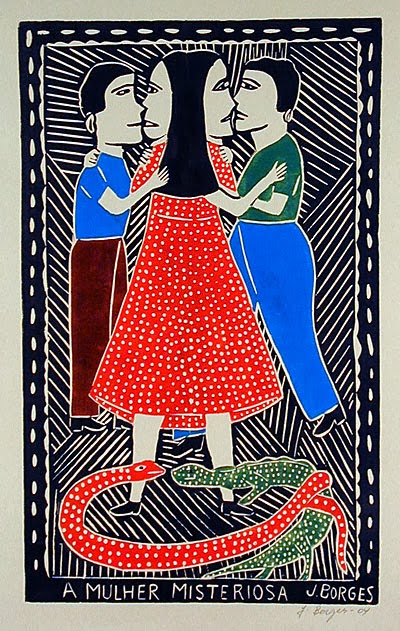
Jose Francisco Borges' Prints on the Life and Culture of Brazil


José Francisco Borges was born in 1935 in Bezerros, Brazil. He is Latin America’s best-known folk artist working in relief, and his work has been exhibited all over the world. He comes out of a long tradition of folk poet/artists who publish their own work in the form of small inexpensive chap-books written in verse, known as folhetos or literatura de cordel, because vendors sell them in the marketplace, hanging over a string.


The backcountry of Brazil is as big as the state of Texas, and it is filled with cowboys, bandits, simple folk and a strong sense of faith. The people from this area are descended from the Portuguese, and they have come to enjoy hearing story-telling poems set to song. These poems are sung by traveling minstrels who spread local gossip as they move from town to town. Frequently, vendors sing these songs to market crowds, many of whom are illiterate, and their voices usually draw enormous gatherings.


Brazilian chap books deal with popular poetry, accounts of local catastrophes, popular legends, famous crimes, and infamous love affairs. The front of these pamphlets usually contain simple, eye-catching illustrations of the book's contents, and they have become a special type of folk art.


Borges worked as a child in the remote fields of north-east Brazil. In his 20s, he started trading, making and illustrating books of popular poems, which lead him from Brazil’s backlands to exhibitions at some of the most prestigious art museums in the world. When Borges wrote and illustrated his first book, he sold 5,000 copies in two months! He has created over 250.


In the 1960s, Borges began writing folhetos, and soon also began to operate a printing press to produce woodcut prints for their covers. He then started producing folio-sized prints from their woodcuts, transforming them into an art form by themselves.


His bold, naive compositions, inspired by politics and folklore, are prized by collectors and shown in exhibitions around the world. Borges received a UNESCO cultural award in 2000. Borges still lives and works in Bezerros. He retains a plain view of his inspiration, saying: “I carve what I see.”


Borges work is simple, colorful and exudes a felling of childlike wonder. His images of two-timing women, marriage and fighting the temptations of the Devil are all done in a playful manner, easy for the viewer to digest.


Many galleries handle Borges' work, and you can easily find them online for a song. No pun intended. Snap some up, my dear inked up comrades, as we must support our brethren.

Monday, April 25, 2016

Werner Drewes' Abstractions in Print

I recently saw the work of Werner Drewes and thought, "Man, how did I never see this person's work before?" It is pretty spectacular, in range and subject. He is a master of the cut mark and composition. The Variety of his color work is soft to bold and the simplicity of a female portrait is so complex it shatters our notions of a simple, yet descriptive mark. I, for one, am riveted by his work, and I hope you will enjoy this man's oeuvre as much as I have. Be sure to share this article with anyone working in printmaking, because we need to share our fellow printmaker's work with each other.
Werner Drewes (1899–1985) was a German-American artist/teacher widely considered to be one of the founding fathers of American abstraction, and one of the first artists to introduce the ideas of the Bauhaus school to the United States.

Drewes was born in Canig, Germany. In 1917, he was drafted by the German army and served in France. After the war, he made art and traveled Europe. He studied architecture at both the Königlich Technischen Hochschule Charlottenburg and at the Technischen Hochschule Stuttgartand. He then enrolled in Stuttgart's school of applied arts (Kunstgewerbeschule) and joined a group of artists and architects associated with the newly formed Merz Akademie, a college of design, art, and media in Stuttgart. He also studied at the Bauhaus, with teachers Johannes Itten, Lyonel Feininger, and Paul Klee.

In 1923 and 1924 he studied art during travels throughout Italy, Spain, the United States, and Central America and in 1926 he traveled to San Francisco, Japan, and Korea, Manchuria, Moscow, and Warsaw. He resumed study at Bauhaus in 1927, in Dessau. He studied with László Moholy-Nagy, Wassily Kandinsky, and Lyonel Feininger. With the rise of Nazism, Drewes emigrated to the United States in 1930. His work soon captured the attention of the New York critics.

Drewes began to teach at the Brooklyn Museum Art School funded by the Federal Art Project of the Works Progress Administration. In 1936, he became an American citizen and a founding member of both the anti-fascist American Artists' Congress and the avant-garde American Abstract Artists group. Healso participated in group shows held by Société Anonyme at Black Mountain College, in North Carolina. The next year, Drewes obtained a position at the School of Architecture of Columbia University. During this time, he made prints for the Graphic Arts Division of the WPA Federal Art Project in New York.
In 1940 he opened an art school called the Department of Abstract Art at the Master Institute of United Arts. In 1944 and 1945 he worked at Stanley William Hayter's Atelier 17 in New York City. Together, they improved the intaglio technique in color print-making.


In 1945 Drewes taught at Brooklyn College and then shifted to Chicago where he joined with Moholy-Nagy to teach at the Institute of Design. In 1946 he joined the faculty of the School of Fine Arts at Washington University in St. Louis. He retired in 1965 and moved to Reston, Virginia.
As a prolific printmaker, Drewes produced some 732 prints, including 269 etchings and drypoints, 30 lithographs, 14 celloprints, a lone silkscreen, and 418 woodcuts. His mature style encompassed nonobjective and figurative work and the emotional content was consistently expressive. Enjoy, my inked up brethren!

Tuesday, April 5, 2016

George Elbert Burr's Passion for the Southwest

Thinking of warmer climates and the beauty of the southwest led me to discover the work of George Elbert Burr (1859–1939). I immediately fell in love with his work and felt transported to Arizona once I saw his images of the Sonoran desert. For anyone enthralled with this part of the world, Burr gets it right when he describes the landscape's great sense of space and open sky. His sensitivity for light is key in these images; which helps one feel the time of day and the season of the year. (Yes, deserts experience seasons, too.)


Burr captures the beauty of this rugged landscape and the plants and trees one can find there, but he also has a command of the area's mountainous terrain and the intimacy and openness we can find walking among the rocks and ravines. I think you will agree with me that Burr's work has an honesty for observation and a respect for Mother Nature. His works come up for auction from time to time, and the prices are reasonable for anyone wanting to add his printed gems to their collection. Enjoy, and see if these images don't draw you to take a trip out west to see them for yourselves.


BIO
George Elbert Burr
was an American printmaker known for his images of the American southwest. He is widely regarded as one of the finest of the early 20th-century American printmakers.


Born in Munroe Falls, Ohio, Burr moved with his parents to Cameron, Missouri, where his father ran a hardware store. Burr was interested in art from an early age and his first prints were created with the use of a press located in his father's store.


In 1878, Burr attended the Art Institute of Chicago (then called the Chicago Academy of Design). He studied there briefly, then achieved commercial success as an illustrator, providing illustrations for Harper's, Scribner's Magazine, Frank Leslie's Weekly, and The Cosmopolitan. From 1892-1896, he illustrated a collection of jade antiquities for the Metropolitan Museum of Art. During this project Burr produced etchings of over a thousand artifacts.


After an illness, Burr moved to Denver for his health and it was there that he began Nature studies and the Rocky Mountains. Burr spent his winters traveling through the deserts of Southern California, Arizona, and New Mexico, which prompted him to move permanently to Phoenix. The southwestern landscape and its expansive views of the Sonoran and Mojave deserts were fascinating to him, and he focused entirely on that subject for the rest of his career.


He was a member of New York Society of Etchers and the Brooklyn Society of Etchers, and president of the Phoenix Fine Arts Association. During his career, Burr created over twenty-five thousand etchings, all pulled from his own presses.

Public Collections:
Art Institute of Chicago
Boston Museum of Fine Arts
Brooklyn Museum
Carnegie Institute
Cleveland Museum of Art
Denver Art Museum
Detroit Institute
Fogg Art Museum
Library of Congress
Los Angeles County Museum of Art
Metropolitan Museum of Art
New York Public Library
Smithsonian American Art Museum
Toledo Museum of Art
Bibliothéque Nationale
Victoria and Albert Museum
British Museum