An owl seeks its prey under stealth of night under a moonlit sky....A hawk surveys its domain on its lofty perch....A mother and father protect their young hatchlings....All this and more is seen through the wonder-filled eyes of Colin See-Paynton.
See-Paynton is a self-taught printmaker (who lives in Wales) whose love of nature is reflected in animals that nest, birds that fly and rabbits that scurry underbrush in the night. His delightful portrayal of these creatures is not merely descriptive, but also fanciful. There is a story waiting to be told in each of his prints. The loving care with which he describes these animals, and the sometimes playful manner in which they cross each other's paths is charming and curious. I want to know more about the rabbit that crosses the owl like they are both going lickity-split, faster than light, and suddenly find themselves nearly missing running into each other. The confusion on the face of the rabbit says it all, like "Hey man, slow down! I am supposed to be the fastest thing running around here."
Similarly, the fox and the owl are racing toward their prey as they jump over a slip of a moon, with the celestial stars to illuminate their way. There is a race going on to be sure, but they seem more intent to race and beat each other, rather than catch a little bite to eat.
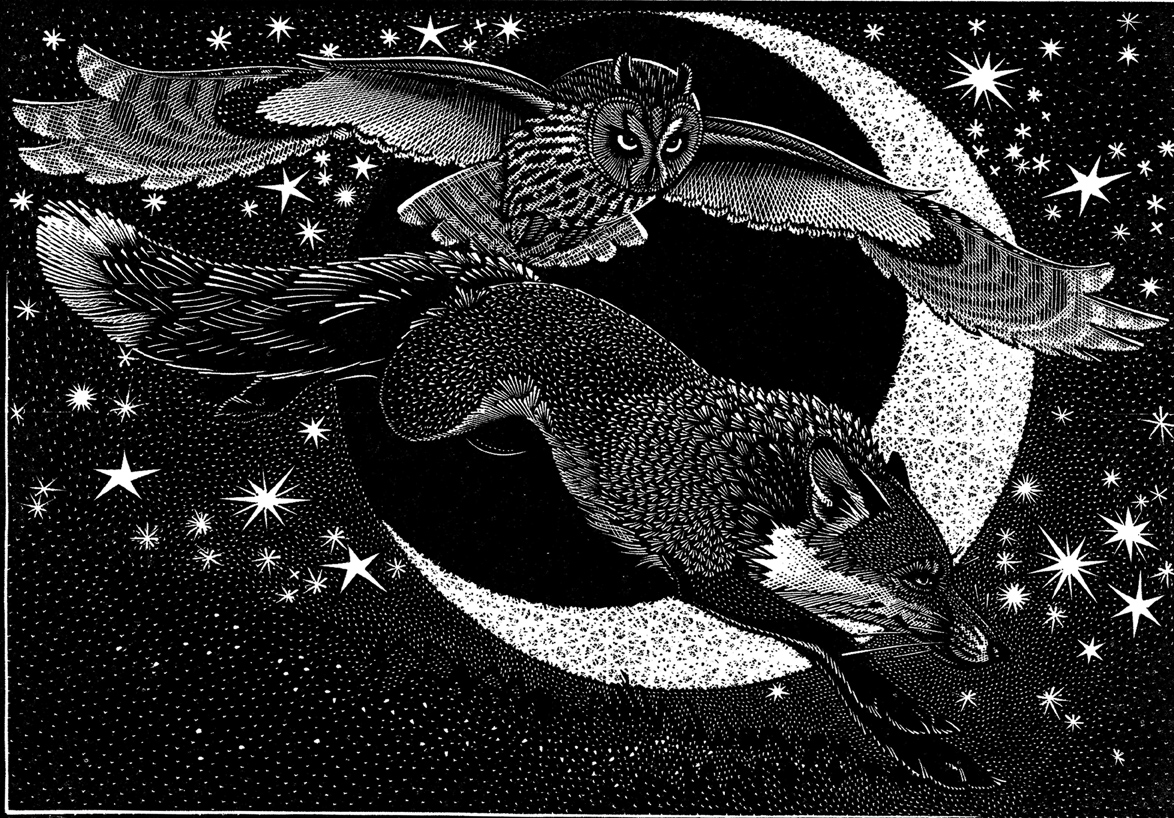
See-Paynton captivates his audience with his subject, but also the mythical places in which they dwell. There is a sort of no man's land his subjects run and fly through, but if we allowed ourselves to wander into a wood, I am sure we would see and hear the same subjects flit by our feet and swoop by our heads. See-Paynton shows us a quieter place and time, where the rush to get to work or the hassles of a day-to-day job fade away as we contemplate the lightning speed of a hawk as it chases its prey, or the hear the quiet ripples of water in a brook as ducks look under the surface of the water to see the catfish meandering below.
See-Paynton clearly loves his work, and the images are beautifully crafted with a deft precision and variety of line. His is a world full of wonder and observance of the laws of nature. Hopefully, we can all spend a little time out in the less traveled world and delight in what we discover.
Memberships:
1983 Associate of the Royal Society of Painter Etchers and Engravers
1984 Member of the Society of Wood Engravers
1986 Fellow of the Royal Society of Painter-Printmakers
1993 Fellow of the Royal Cambrian Academy
Public Collections:
Ashmolean Museum, Oxford
Belfast City Art Gallery, Belfast, Ireland
Berlin Graphothek, Berlin, Germany
Central Museum & Art Gallery, Northampton
Freemantle Museum & Art Gallery, Australia
Guangdong Museum of Art, China
Museum of Modern Art, Wales
National Library of Wales, Aberystwyth, Wales
National Museum of Wales, Cardiff, Wales
Swansea Museum & Art Gallery
Victoria & Albert Museum, London, England
A place for talking about art, social issues, and most anything else I think THAT'S INKED UP.
Showing posts with label Engraving. Show all posts
Monday, December 4, 2017
Tuesday, October 9, 2012
Mauricio Lasansky 1914-2012, Beloved Patriarch of American Printmaking
Before I embark upon the biography of this amazing man, I want to relate some thoughts. I will confess that I dreaded the day would come when the famed and highly esteemed printmaker/teacher Mauricio Lasansky would leave this world for a better place. I mourned his passing as though my own grandfather had died, because I felt in fact he was my artistic and spiritual ancestor. At least, that's what I came to feel having studied with one of his students, Robert Wolfe, at Miami University(OH).
Wolfe's stories of having studied at the US printmaking mecca in the 1950s was all about teaching us 'print newbies' the history of this medium and the noble merits of one's blood, sweat and toil on a piece of metal plate; to create a message that will burn itself into the viewer's memory, or at least tell a story. One of his first year graduate student tales related to one's fear of the initial mark, diving into the abyss not knowing what the image will be but going at it headlong with no restraint. He told us that all first year graduate students had to first do a self-portrait engraving on a full sheet of copper. After they completed that phase of the project, they were told to completely scrape down the image as though it never existed. Wolfe always brought out examples of that first endeavor for us to admire, then he carefully taught us how to use the tools to make our own self-portrait engraving. One felt the meticulousness of his[Wolfe's] teaching method was handed down from the Master, and we all aspired to do well with our own project. It was inherently understood that not only our professor, but Lasansky himself was watching what we were doing. I digress, but I think you understand, that was the way it was done, and the Only way it should be done. The connection to him, albeit through his students, was so strong that we felt as though we were taught by Lasansky himself. One can see it is a great testament to his influence and contributions to the medium. Now for the real article.....jpg)
.jpg)
Mauricio Leib Lasansky (1914-2012) was an Argentine-American graphic
artist and printmaker. He chose to focus his artistic energies on the
development of printmaking and drawing, thus making him one of a few Modern era
artists to do so. The result is a life full of experimentation and dedication
to his craft. Lasansky is widely considered to be one of the pioneers in the graphic
arts evolution and making the art world look at the medium as critically as any
other field. He will forever be enshrined as one of the first and best generations
of artists who have defined and guided printmaking in the United States. He is
revered as one of the true "Fathers of 20th Century American
Printmaking."
Born in Buenos Aires, Argentina, Lasansky’s
parents were Eastern
European Jews; his Lithuanian-born father, who had made his way to Argentina via North America,
had worked as a printer and engraver at the US Mint in Philadelphia. As a
talented and ambitious young man of 22, Lasansky became Director of the Free
Fine Arts School, in Villa Maria, Cordoba, Argentina. Six years later, he was
honored with the first of five highly coveted Guggenheim Fellowships, and he
went to the United States to the Metropolitan Museum of Art to study their print
collection, which numbers well over 100,000! While there, he learned the
history of printmaking and networked with other artists who had also moved to
the states.
After Mauricio married Emilia Barragan in 1937, he began to exhibit his work, regularly winning
awards and prizes, and in the 1940s he
and many other artists began to work in printmaking through the WPA graphic arts workshops. Several printmaking
studios were established and Lasansky chose to work at the famous Atelier 17, which was established by British
artist Stanley William Hayter. Atelier
17 was the first independent American workshop devoted to the Intaglio printmaking process
and it developed an international reputation. The artists from this era , like Mark
Rothko and Jackson Pollock, who also worked
at Atelier 17, are now referred to as the New York School and their Abstract Expressionist method
of working changed intaglio printmaking in America. Many of these artists’
experiments in intaglio printmaking lead to them being invited to organize
printmaking departments in universities all across the country.
In 1945, Lasansky was invited to direct and teach the printmaking
program at the University of Iowa, in Iowa City, IA. The program became one of
the premiere places to study printmaking in the US, producing hundred and
hundreds of artists/teachers. At the time of his death, Lasansky was recognized
as the Virgil M. Hancher Professor Emeritus,
head of Printmaking in the School of Art and Art History, where he had taught
for more than forty years.
Many
of Lasansky's former students went on to teach at reputable universities to
spread the word about printmaking. Some of those former students include Keith Achepohl, Glen Alps, Lee Chesney,
David Driesbach, John Ilhe, John Paul Jones, and Robert Wolfe. The passing of the printmaking torch from
generations of teachers to students is what marks the legacy of Atelier 17,
Hayter and Lasansky.
Lasansky’s art is known for his large scale prints (some
being four by eight feet in length), utilizing multiple plates (up to 60) and in
full color. He even designed a specially-milled French paper for his prints so
they would withstand a large amount of printing which often combined etching, drypoint, aquatint
and engraving intaglio
techniques. Throughout his career, he preferred figurative subjects, seeing
them as important as the technical side of his work.
Lasansky is internationally known for a series that marked a departure from his beloved intaglio method,
The Nazi Drawings, This series speaks in a most
raw and scathing manner about the brutality of Nazi Germany upon its victims. He worked six
years on the project, which consists of thirty individual life-sized pieces and
one triptych. Their effect upon the viewer is shock and horror. His figures are
like ghosts passing through Hell, and he shows them living through their fears in
a nightmare that disgustingly was real. Surprisingly,
the drawings were created primarily with lead pencil on common commercial
paper. "I wanted them to be done with a
tool used by everyone everywhere. From the cradle to the grave, meaning the
pencil." And speaking
of his inspiration, he said…“The Hitler
years were in my belly, and I tried many times to do the drawings,” he said. “But
then I decided, the hell with it. Why don’t I just put down what I feel? The
fact is that people were killed — how cool can you play that?” The Nazi
Drawings was one of the first exhibits ever shown at the Whitney Museum of American Art and have been
exhibited in many prominent art museums. They can now be seen at University of Iowa Museum of Art.
In closing, Mauricio Lasansky created some of the most powerful
images in contemporary art. He has contributed significantly to printmaking being
considered a critical and serious art form of the 20th century and for that our
[printmakers] debt to his commitment cannot be repaid.
Awards and Honors:
*Five Guggenheim Fellowships!
*Six honorary Doctorate
of Arts degrees
*His work is represented in more than one hundred public
collections including virtually EVERY major museum in the United States i.e. the National Gallery of Art
in Washington, DC., the Art Institute of Chicago and the Brooklyn Museum of Art.
*Internationally recognized, he has been exhibited throughout
North and South America, Europe and Russia.
*Became a US citizen in 1952
Subscribe to:
Posts (Atom)


.jpg)

.jpg)

.jpg)