Antonio Frasconi was born in 1919 in Buenos Aires, Argentina, but grew up in Uruguay's capital, Montevideo, Uruguay, by parents of Italian decent. As a young boy, by the age of 12 he was already making images. He started out making copies of Mickey Mouse, but soon afterward he learned about printing and he drew political cartoons for newspapers.He was attracted to making multiple image so he could afford to keep his prices reasonable.
Frasconi loved Paul Gauguin's colorful work and le was enamored of American jazz music. In 1945, at the end of World War II, he moved to the United States and worked for a short time as a gardener at the Santa Barbara Museum of art. Soon afterward he earned a scholarship to attend the art Student's League in new York City. From there, he went to study at the New School of Research.
"For me, New York City was a place for living and learning the good and the bad," he said. In the early '50s, he met and married fellow artist Leona Pierce, who had also studied at the Art Students' League. The Frasconis left New York City in 1957, moving to the more sedate and peaceful Norwalk, after the birth of their second son, Miguel. Frasconi's sons are also artists: Miguel is a composer and glass harmonica musician, and Pablo, is a filmmaker, whose work includes a 1985 film, called "The Woodcuts of Antonio Frasconi."
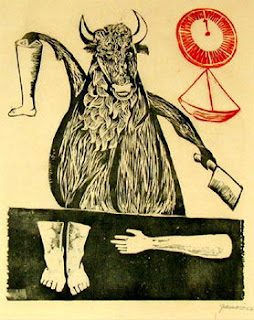
By the 1950’s, Frasconi was recognized as one of America’s foremost pintmakers. His woodcuts are concerned with social and political issues for a long time. His bold and forceful images addressed the atrocities of the Vietnam and Iraq wars. One of his greatest and most personal projects was a series of prints called Los Desparacidos, or the Disappeared. It was about the thousands of men and women who had been victims of the brutal dictatorships of Latin America in the 1970s and 1980s. This project further fueled his interest to pursue making images about social protest and he continued to do so. Sometimes brutal in their clarity or making a quiet but pointed comment on the plight of migrant workers toiling day and night to bring in the crops, Frasconi was not shy when it came to his opinions.
Antonio Frasconi, remained a resident of Norwalk, still printmaking. His studio overlooked one of the beautiful coastal salt marshes in Norwalk, Connecticut, and captured the patterns and colors of the grasses and estuaries, the tidal flats, the waterfowl and flocks of migratory birds, and the sky.
Frasconi's color combinations are like watching music, they are at times jazzy, vibrant, then muted. Later in his career, he became closely in tune with Nature and its ebb and flow of the tides, seasonal color changes and nuances of the Norwalk landscape.
As an educator, he taught art at School of Art and Design at SUNY Purchase for 35 years. Frasconi also taught art at the Rowayton Art Center in the 1960s. By then, he was a well- established graphic artist, whose prints were a recognizable visual commentary for contemporary political and social issues.One of Frasconi's former students, Norwalk resident Virginia Bates, said of his courses, "It was wonderful. It was the most stimulating class I ever took."
For the past 50 years or so, the landscape around Frasconi's home in Norwalk's Village Creek community, have found their place amongst the artist's prints. The print to the right here represents his observations well. Men are quietly going about their business, hoping their efforts will prove fruitful.... As to why he was attracted to woodcuts, Frasconi said it was difficult to answer. His approach to making prints was always by instinct more organic and painterly. The artist said his later work glorifies the landscape, yet he feels the encroachment of development and time changing the natural surroundings to something more suburban.

One understands he means that twofold, where the natural environment is lovely and peaceful, but the mark of man is inescapable. Kirk said that although Frasconi's earlier body of work is known for its political commentary, his most recent works depict more peaceful themes of nature. Filled with beauty and tranquility, the prints convey marshlands and tidal rivers as viewed from his home."They depict the wetlands of South Norwalk, a stone's throw from his studio windows, as they merge into the distance with the waters of Long Island Sound. This scene is always transforming, and the prints on view change with the seasons as the migrating birds fly across these landscapes/seascapes.
Awards and Accolades:
Art Student’s league – 1945
Guggenheim Foundation award – 1952
U.S. postage stamp - 1963, honoring the centennial of the National Arts and Sciences
Represented Uuguay at the 1968 Venice Biennale
Distinguished teaching Professor of Visual Arts at SUNY, Purchase – 1982
Illustrator and designer of over 100 children’s books
Artwork published in magazines, a and various album covers.
Artwork in cluded in the follwoing public collections:
Metropolitan Museum of Art, the Museum of Modern Art, the New York Public Library, the National Gallery of Art and the Smithsonian Institute


