In commemoration of Warrington Colescott's significant achievements in printmaking, I am re-posting this article on his work. R.I.P. 9/14/2018
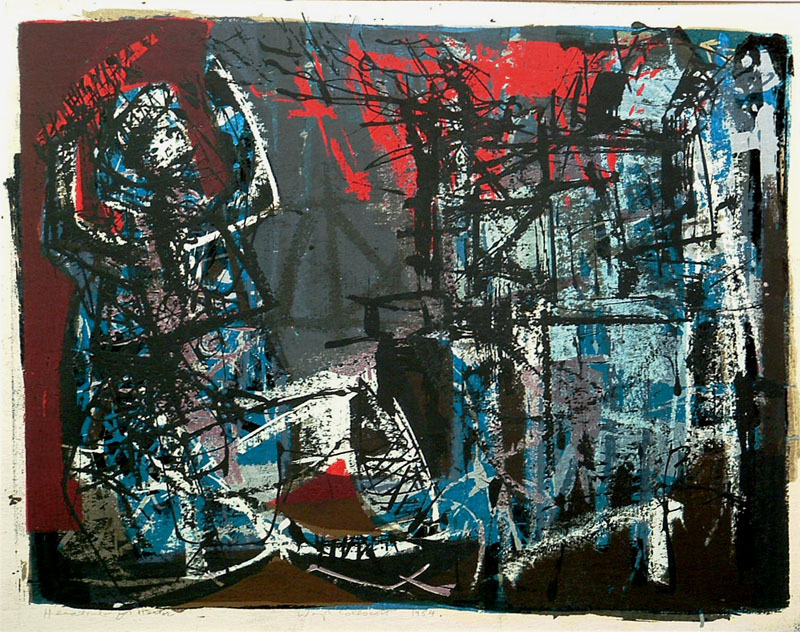
Warrington Colescott is mostly known as an American printmaker of satirical subjects. His work expresses a vivid imagination, interpreting contemporary and historical events. Yet, in his earlier more abstract phase, his work borders on something reminiscent of the curvilinear figures one finds in the works of Matisse and Cezanne; and the arabesque gestural lines he uses deftly lead the viewer through the composition to see all the lovely, weirdly grotesque and erotic figures we find therein. This article will focus on his earlier work, which shows his homage to Hayter and other well-known artists.
Colescott was born in 1921 to Warrington, Sr. and Lydia Colescott. His parents who were of Louisiana Creole descent moved to Oakland in 1920 where he was born. His younger brother, Robert, is also an artist. Comic strips, vaudeville and the burlesque at Oakland’s Red Mill/Moulin Rouge theater were important influences upon Colescott’s work. He made cartoons and did some writing for both the Pelican and The Daily Californian when he attended University of California at Berkeley.
Colescott studied painting at the University of California, Berkeley, and started to make prints in 1948 while he was teaching at Long Beach City College. He continued to make prints when he moved to Wisconsin to teach at the University of Wisconsin - Madison. Alfred Sessler introduced Colescott to etching in the mid-1950s, and Colescott continued to his study of printmaking at London’s famous Slade School of Fine Art.
Colescott gained critical attention in the 1950s, when he was included in the Museum of Modern Art’s 1953 Young American Printmakers exhibition, and exhibits at the Whitney Museum of American Art in 1955 and 1956. Critics have compared his graphic and satirical style, to artists like Francisco Goya, Honoré Daumier, Max Beckmann, and George Grosz.
His early graphic work was more abstract. That work contains some reference to the linear flow of Stanley William Hayter’s work, but his colors are dark and sometimes more tonal than colorfully expressive. By the early 1960s his satirical imagery evolved and he devoted his time to complex color etching, and incorporated bits of letterpress into his compositions. As his work became less abstract and more narrative, this allowed him to fully explore his satirical commentary on subjects of the civil rights struggles in the South, racism, violence, and a series on Depression-era gangster, John Dillinger.
Colescott’s mature style became evident in his series The History of Printmaking (1975–78), where he describes important developments in the evolution of printmaking with various printmakers. Since the 1970s, Colescott has continued to pursue social satire in his work with subjects on burlesque, popular culture, the afterlife, and places like California, Wisconsin and New Orleans, the home of his ancestors. Recently, Colescott has turned his attention to the Middle East conflicts in Iraq and Afghanistan. He lives and works in Hollandale, Wisconsin.
Education
1942 - BFA at the University of California, Berkeley.
1942-46 – served in the Army in World War II
1947 - MFA at the University of California, Berkeley
1947-1949 taught art at Long Beach City College
1949- 1986 taught at the University of Wisconsin–Madison
Continuing studies:
1952-53 -Académie de la Grande Chaumière, Paris
1956–57 Fulbright Fellow, Slade School of Fine Art, University of London
1963 - Guggenheim Fellowship, London
Exhibitions
1979 – A History of Printmaking, Madison Art Center
1988-89 Elvehjem Museum of Art (now the Chazen Museum of Art), University of Wisconsin–Madison
1996 and 2010 - Milwaukee Art Museum
Honors
1957 - Fulbright Fellowship
1965 - John Simon Guggenheim Memorial Foundation Fellowship
1975 - National Endowment for the Art Printmaking Fellowship
1979 & 1983 - National Endowment for the Arts
1992 - Academician of the National Academy of Design
Fellow of the Wisconsin Academy of Sciences, Arts, and Letters
Collections
Art Institute of Chicago
the Bibliothèque Nationale de France
Brooklyn Museum
Carnegie-Mellon Museum
Chazen Museum of Art in Madison
Cincinnati Art Museum
Columbus Museum of Art
Los Angeles County Museum
Madison Museum of Contemporary Art
Metropolitan Museum of Art
Milwaukee Art Museum
Museum of Modern Art
Museum of Wisconsin Art in West Bend
National Gallery of Art
New York Public Library
Portland Art Museum
Smithsonian American Art Museum
Tate Gallery of Modern Art
Victoria and Albert Museum
Whitney Museum of American Art
A place for talking about art, social issues, and most anything else I think THAT'S INKED UP.
Showing posts with label female nudes. Show all posts
Wednesday, July 8, 2015
Tuesday, December 2, 2014
Chicago's Own Printmaker, Eldzier Cortor
The joy of this blog is when I find some new, or elder, printmaker’s work that I haven’t seen before. We have some mighty fine colleagues out there, and Eldzier Cortor is one of the good ones. I hope you enjoy his work as much as I do. Recently, a major gift of Cortor’s work was given to the Art Institute of Chicago, and anyone can make an appointment go see Cortor’s prints in their fabulous Print & Drawing Room.
Notable for his prints and paintings, African-American artist and printmaker Eldzier Cortor was born in 1916, in Tidewater, VA, to John and Ophelia Cortor. His family was a part of the Great Migration of African Americans from the rural south to the industrial north at the beginning of the 1900s. His family moved to the south side of Chicago when Cortor was about a year old. He later attended Englewood High School with other notable African-American artists, such as Margaret Burroughs and Charles Wilbert White.
He attended the Art Institute of Chicago, gaining a degree in 1936. While there, he came under the influence of instructor Kathleen Blackshear, who led students to explore the regional arts of Africa and other non-Western cultures at University of Chicago’s Oriental Institute, and the Field Museum. Studying the African sculptures at the Field Museum transformed his work. "That was the most important influence in all my work, for to this day you will find in my handling of the human figure that cylindrical and lyrical quality I was taught...to appreciate in African art."
He also studied at the Institute of Design. Cortor, like his peers in the Harlem Renaissance, sought to reclaim his ancestral heritage as a means of informing and empowering his art. He searched for positive Black imagery, which he found in Chicago’s South Side working-class, in the former slave cultures of the U.S. South and Caribbean, and, finally, in the iconic Black female figure.
In 1940 he worked with the Works Progress Administration (WPA), where he drew scenes of Depression-era Bronzeville, a near south side Chicago neighborhood. Cortor received two Rosenwald Foundation grants, in 1944 and 1945, to live with the Gullah people in the Sea Islands off the coast of Georgia and South Carolina. In 1949, Cortor received a Guggenheim Fellowship to study in Jamaica, Cuba, and Haiti, and he taught at the Centre d'Art in Port-au-Prince from 1949–1951.
During his career, Cortor produced several prints in the mid-1950s with Japanese printmaker Jun’ichiro Sekino, who was a leading member of the Sosaku Hanga, or Creative Prints, movement. Between 1955 and 1998, he made experimental prints at New York’s famous Robert Blackburn’s Printmaking Workshop.
Cortor was one of the first African-American artists to make African-American women his primary theme, saying, "the Black woman represents the Black race, continuance of life." These women have been a central focus of Eldzier Cortor’s work for much of his career; their elongated sculptural features appearing timeless and modern. It was when Cortor lived with the Gullah people that he became fascinated with their deep cultural African ties to their ancestry, and this prompted him to depict Woman as an archetypal image.
Cortor’s work is also influenced by surrealism, "who often uses the female figure in a surreal interior and exterior environment." While much of his work displays a strength and hopefulness, other series, such as his Haitian-influenced slaughterhouse series speak of suffering, oppression and racism. The lasting impression of Cortor’s work shows his pride of his ancestry, and love of the female form. These compositions show off, unabashedly, Cortor’s free expressive color, form and loose compositions; and the female nude as tall, lean powerful and sensual figures. His gift to the Art Institute of Chicago cannot be diminished in importance because he is one of the major figures of Chicago’s African American art scene. We can only hope to see more of his work as he continues to make art, and especially prints.
Exhibitions:
1938 - "An Exhibition in Defense of Peace and Democracy", the Chicago Artists' Group
1940 - "The Exhibition of the Art of the American Negro", in Chicago.
1967 - City College of New York, "The Evolution of Afro-American Artists: 1800 - 1950"
1976 - Los Angeles County Museum of Art, "Two Centuries of Black American Art", (which toured the U.S. in 1977.)
1988 - "Three Masters", Kenkeleba Gallery, NY, (with Hughie Lee-Smith and Archibald Motley)
2002 - "Eldzier Cortor: Master Printmaker", Boston Psychoanalytic Society and Institute, MA
2010 - Library of Congress, Washington, D.C.
2010 - Indiana University Art Museum, Bloomington, IN
2013 - San Antonio Museum of Art, TX
Collections:
Howard University
The Smithsonian American Art Museum
The Art Institute of Chicago
Awards:
Art Institute of Chicago, Advisory Committee’s Legends and Legacy Award
Publications:
Matthew Backer and Jennifer Heusel, “Black Spirit”: Works on Paper by Eldzier Cortor (Indiana University Art Museum, 2006).
Notable for his prints and paintings, African-American artist and printmaker Eldzier Cortor was born in 1916, in Tidewater, VA, to John and Ophelia Cortor. His family was a part of the Great Migration of African Americans from the rural south to the industrial north at the beginning of the 1900s. His family moved to the south side of Chicago when Cortor was about a year old. He later attended Englewood High School with other notable African-American artists, such as Margaret Burroughs and Charles Wilbert White.
He attended the Art Institute of Chicago, gaining a degree in 1936. While there, he came under the influence of instructor Kathleen Blackshear, who led students to explore the regional arts of Africa and other non-Western cultures at University of Chicago’s Oriental Institute, and the Field Museum. Studying the African sculptures at the Field Museum transformed his work. "That was the most important influence in all my work, for to this day you will find in my handling of the human figure that cylindrical and lyrical quality I was taught...to appreciate in African art."
He also studied at the Institute of Design. Cortor, like his peers in the Harlem Renaissance, sought to reclaim his ancestral heritage as a means of informing and empowering his art. He searched for positive Black imagery, which he found in Chicago’s South Side working-class, in the former slave cultures of the U.S. South and Caribbean, and, finally, in the iconic Black female figure.
In 1940 he worked with the Works Progress Administration (WPA), where he drew scenes of Depression-era Bronzeville, a near south side Chicago neighborhood. Cortor received two Rosenwald Foundation grants, in 1944 and 1945, to live with the Gullah people in the Sea Islands off the coast of Georgia and South Carolina. In 1949, Cortor received a Guggenheim Fellowship to study in Jamaica, Cuba, and Haiti, and he taught at the Centre d'Art in Port-au-Prince from 1949–1951.
During his career, Cortor produced several prints in the mid-1950s with Japanese printmaker Jun’ichiro Sekino, who was a leading member of the Sosaku Hanga, or Creative Prints, movement. Between 1955 and 1998, he made experimental prints at New York’s famous Robert Blackburn’s Printmaking Workshop.
Cortor was one of the first African-American artists to make African-American women his primary theme, saying, "the Black woman represents the Black race, continuance of life." These women have been a central focus of Eldzier Cortor’s work for much of his career; their elongated sculptural features appearing timeless and modern. It was when Cortor lived with the Gullah people that he became fascinated with their deep cultural African ties to their ancestry, and this prompted him to depict Woman as an archetypal image.
Cortor’s work is also influenced by surrealism, "who often uses the female figure in a surreal interior and exterior environment." While much of his work displays a strength and hopefulness, other series, such as his Haitian-influenced slaughterhouse series speak of suffering, oppression and racism. The lasting impression of Cortor’s work shows his pride of his ancestry, and love of the female form. These compositions show off, unabashedly, Cortor’s free expressive color, form and loose compositions; and the female nude as tall, lean powerful and sensual figures. His gift to the Art Institute of Chicago cannot be diminished in importance because he is one of the major figures of Chicago’s African American art scene. We can only hope to see more of his work as he continues to make art, and especially prints.
Exhibitions:
1938 - "An Exhibition in Defense of Peace and Democracy", the Chicago Artists' Group
1940 - "The Exhibition of the Art of the American Negro", in Chicago.
1967 - City College of New York, "The Evolution of Afro-American Artists: 1800 - 1950"
1976 - Los Angeles County Museum of Art, "Two Centuries of Black American Art", (which toured the U.S. in 1977.)
1988 - "Three Masters", Kenkeleba Gallery, NY, (with Hughie Lee-Smith and Archibald Motley)
2002 - "Eldzier Cortor: Master Printmaker", Boston Psychoanalytic Society and Institute, MA
2010 - Library of Congress, Washington, D.C.
2010 - Indiana University Art Museum, Bloomington, IN
2013 - San Antonio Museum of Art, TX
Collections:
Howard University
The Smithsonian American Art Museum
The Art Institute of Chicago
Awards:
Art Institute of Chicago, Advisory Committee’s Legends and Legacy Award
Publications:
Matthew Backer and Jennifer Heusel, “Black Spirit”: Works on Paper by Eldzier Cortor (Indiana University Art Museum, 2006).
Subscribe to:
Posts (Atom)


