Ambitious, bold and mesmerizing. Those are some aptly coined phrases one would hear when seeing the work of Angela Cavalieri and her mammoth-sized prints and book works.You know, one could work smaller, as is often the case when making prints, but Cavaleieri is a risk-taker and aggressively hits the floor running with her work. The blend of scale, lettering and architecturally referenced shapes build a code she works with to create narrative structure through the printed letters and words. The images tossle between varying scales and the text is large and clunky, pleasingly so. The works are a process of evolution and feel as though Cavalieri is drawing them out as she goes.
From Cavalieri's website her biography shares this with us..."Sources include poetry, religious epitaphs and inscriptions on public buildings.Fragments of experience and narrative find their form in the enlarged, broken and repaired text.Seeing the text as an image, she re-writes that part of history by re-working and integrating the text into forms that reinforce its physical and material presence. The narrative is constantly changing and rediscovering itself and new narratives appear."
Yes, we can get that from seeing her work. Anyone can build their own narrative based upon their own experience. The language doesn't impact me as much as the scale of the work and that she often forms architectural units from the shapes she manipulates. This is fine, all good. The actual type and place of the architecture is her own experience, but they are generic enough that we understand what they are.
The other forms that are created seem collaged almost organic. They are imbued with sound or discernment of translation as one hears a language and has to run it through some sort f internal machine to decipher their meaning or translate them to our native tongue. Cavalieri talks about Italian being her fist tongue, and so we sense that eternal need to translate whatever we hear to our base language.
Cavalieri uses the history of printmaking, its communication base to make her images. The lettering and the making of colossal 3D books is a lot of work, and again, the pages often are made into shapes/colonnades of hallways filled with words, cavernous spaces filled with language and sounds we can't totally clearly make out. They are about travels to foreign places and passing through large spaces. The words pass around us and through our senses. We hear them come from all directions and have to choose our pathway through them carefully.
Cavalieri approaches the printmaking process as a tool to make images more often seen from painters. She shares her journeys and travels and responses to poetry with a grand, expressive conviction. We can be impressed with the scale, but it is the content that matters here, and Cavalieri carries her heart and passions on her sleeve and unabashedly puts them out there for all to see. Kudos to her for hanging her emotions and personal feelings out on the line for us to see and hear. Whether you care about her personal journey is not the point. In a world filled with so much information, sometimes we have to make a big statement or say it loud enough for others to take notice. Cavalieri is doing that, and we will continue to take notice and she continues to make her work.
Born in Melbourne, 1962.
Education: 1981-83 Bachelor of Fine Arts, Victorian College of the Arts
Solo Exhibitions:
2011 Parole Viaggante: Angela Cavalieri’s Travelling Words,
La Trobe University Museum of Art and Maroondah Art Gallery, Melbourne
2011 Un’altra Storia, IMPACT7, Monash University, Melbourne
2011 Chiacchierone, Australian Galleries, Smith Street, Melbourne
2008 Passaggi Scritti, Gallery 101, Melbourne
Group Exhibitions:
2011 Venice Biennale, Italian Pavilion in the World Project, Venice, Italy
2011 Manly Library Artist Book Award, Sydney
2011 Fine Impressions, State Library of Victoria, Melbourne
2011 The Rick Amor Print Prize, Montsalvat, Melbourne
2011 Weaving Art and Change, Forty five downstairs, Melbourne
2011 Reframed, Counihan Gallery, Melbourne
2011 Burnie Print Prize, Burnie Regional Gallery, TAS
2010 Artists’ Prints made with Integrity 1, Australian Galleries, Melbourne
2010 The 36th Alice Prize, Araluen Centre, Alice Springs, NT
2009 The Counihan Connection: Noel Counihan and Contemporary Artists, Counihan Gallery, Melbourne
2009 Hutchins Art Prize, Long Gallery, Hobart, TAS.
2009 Geelong Print Prize, Geelong Art Gallery, VIC.
2009 Works on Paper Art Prize, Banyule City Council, VIC
2009 Silk Cut Acquisitive Award, Glen Eira Arts Complex, Melbourne, VIC
2009 Surveying the Field, Counihan Gallery, Melbourne, VIC
2009 Books….beyond words, Highly Commended, East Gippsland Art Gallery, VIC
2009 Book Crossing – from the Deakin University Artists’ Book Collection, Geelong Art Gallery, VIC
2009 DLAP: City of Darebin La Trobe University Acquisitive Art Prize. VIC
2009 Transitions: European Island and Regional Cultures, La Trobe University Art Gallery, VIC
2009 CPM Print Acquisition Awards, Highly Commended Tweed River Regional Art Gallery, NSW
Residencies:
Australia Council Overseas Development Grant for Barcelona
Piramidon Centre for Contemporary Art, Barcelona
Edith Cowan University
Australia Council Residency at The British School, Rome
Collections:
Australian National Gallery, Canberra
Art Gallery of New South Wales Library Collection, Sydney
Bailleu Library - Melbourne University
Banyule City Art Collection, Victoria
Deakin University Art Gallery, Victoria
Fryer Library - University of Queensland
Geelong Art Gallery, Victoria
Gold Coast City Gallery, Queensland
Mackay Regional Gallery, Queensland
Manly Library, Sydney
Maroondah Art Gallery, Victoria
Monash University Library, Victoria
Moreland City Council Art Collection
Musees D’art et d’histoire, Geneva
National Gallery of Victoria
Piramidon Contemporary Art Collection Barcelona, Spain
Silk Cut Foundation, Canberra
State Library of New South Wales
State Library of Victoria
Sutherland Shire Council, New South Wales
Whitehorse City Council, Victoria
A place for talking about art, social issues, and most anything else I think THAT'S INKED UP.
Wednesday, January 28, 2015
Monday, January 19, 2015
Dox Thrash's Visceral Portraits of African-Americans
Greetings to all my inked up comrades, and welcome to 2015! This year promises to bring you a lot of new articles on artists, exhibitions and books on our favorite subject - prints! I enjoy hearing your comments on these articles and welcome hearing from you about any new printshops, upcoming workshops, and retreats.
To start the year off, we will look at the work of Dox Thrash (1893-1965), an African-American printmaker originally from Griffin, Georgia, who migrated north as part of the Great Migration. He settled in Chicago and then Philadelphia, producing work on the subject of African-American life. His work is largely recognized as portraying a positive view of African-Americans,promoting the idea of strong characters and bold portraits. Thrash left home at the age of fifteen in search of work up north as part of the Great Migration (African American). He initially got work with a circus, then he moved to Chicago, and got a job as an elevator operator. He studied art, first through correspondence courses and then at the Art Institute of Chicago, where he completed his studies in 1923. During WWI, Thrash joined the army and fought in the Buffalo Soldiers brigade, where he suffered shell shock, but did not suffer any permanent after affects. In 1925, he settled in Philadelphia and took a job working as a janitor. Once in Philadelphia, he decided to study printmaking at the Graphic Sketch Club, now the Fleisher Art Memorial. In his free time, he continued his art and gained recognition for a poster he designed for the 2nd Annual National Negro Music Festival. He also joined the Tra Club of Philadelphia. He was an important member of Philadelphia’s Fine Print Workshop, a division of the Work Projects Administration’s Federal Arts Project, from 1937-1942, and his career flourished with this support.
Thrash mentored many young African American artists. Forty years after his death, Thrash was posthumously honored in Philadelphia with an exhibition called, “Dox Thrash: An African-American Master Printmaker Rediscovered”.
Thrash' view of the south included old cabins with a nostalgic view of his youth. Families living, working and playing around the homestead. laundry onthe line, the family bound together out of survival and out of necessity to survive as a unit. Some of his work depicted the horrific lynching common in the south prior to the Civil Rights movement of the 1960s, but some also present a solemn, even romantic view of man communing with his environment. These prints have the feel of 19th century French paintings and the works of Corot.
Thrash focused on subjects from the city, memories of his early life in rural Georgia, and nudes and portraits. Narrative, sentiment and African-American experience are the key elements of Thrash’s work; his innovative techniques are important only in so far as they dramatically express his subjects.There are several prints showing scenes of rustic cabins in idyllic landscapes. One print, titled "Sunday Morning", shows a woman dressed up and striding along in profile. (The subject of this print has been theorized as being Thrash’s mother walking to church.)
It was the strength of his African Americans portraits that Thrash emphasized over and over, reflecting his African American audience back at themselves, hinting at the psychological expense of attempting to conform to pre-existing white norms while presenting a new vision of the group as strong, positive role models overcoming their past and adversities.
Thrash's style is soft, dark and evokes passion. His line is classically structural and his tones softly Romantic, but the depth of his passion for his fellow man is evident in every rough, coarsely drawn line. His body of prints, which number over 100, are worth a look and can be seen in Ittmann's book which is listed below.
Thrash working in his studio.
Ittmann, John. Dox Thrash: An African-American Master Printmaker Rediscovered. Philadelphia: Philadelphia Museum of Art; Seattle, Washington: University of Washington Press, 2001.
To start the year off, we will look at the work of Dox Thrash (1893-1965), an African-American printmaker originally from Griffin, Georgia, who migrated north as part of the Great Migration. He settled in Chicago and then Philadelphia, producing work on the subject of African-American life. His work is largely recognized as portraying a positive view of African-Americans,promoting the idea of strong characters and bold portraits. Thrash left home at the age of fifteen in search of work up north as part of the Great Migration (African American). He initially got work with a circus, then he moved to Chicago, and got a job as an elevator operator. He studied art, first through correspondence courses and then at the Art Institute of Chicago, where he completed his studies in 1923. During WWI, Thrash joined the army and fought in the Buffalo Soldiers brigade, where he suffered shell shock, but did not suffer any permanent after affects. In 1925, he settled in Philadelphia and took a job working as a janitor. Once in Philadelphia, he decided to study printmaking at the Graphic Sketch Club, now the Fleisher Art Memorial. In his free time, he continued his art and gained recognition for a poster he designed for the 2nd Annual National Negro Music Festival. He also joined the Tra Club of Philadelphia. He was an important member of Philadelphia’s Fine Print Workshop, a division of the Work Projects Administration’s Federal Arts Project, from 1937-1942, and his career flourished with this support.
Thrash mentored many young African American artists. Forty years after his death, Thrash was posthumously honored in Philadelphia with an exhibition called, “Dox Thrash: An African-American Master Printmaker Rediscovered”.
Thrash' view of the south included old cabins with a nostalgic view of his youth. Families living, working and playing around the homestead. laundry onthe line, the family bound together out of survival and out of necessity to survive as a unit. Some of his work depicted the horrific lynching common in the south prior to the Civil Rights movement of the 1960s, but some also present a solemn, even romantic view of man communing with his environment. These prints have the feel of 19th century French paintings and the works of Corot.
Thrash focused on subjects from the city, memories of his early life in rural Georgia, and nudes and portraits. Narrative, sentiment and African-American experience are the key elements of Thrash’s work; his innovative techniques are important only in so far as they dramatically express his subjects.There are several prints showing scenes of rustic cabins in idyllic landscapes. One print, titled "Sunday Morning", shows a woman dressed up and striding along in profile. (The subject of this print has been theorized as being Thrash’s mother walking to church.)
It was the strength of his African Americans portraits that Thrash emphasized over and over, reflecting his African American audience back at themselves, hinting at the psychological expense of attempting to conform to pre-existing white norms while presenting a new vision of the group as strong, positive role models overcoming their past and adversities.
Thrash's style is soft, dark and evokes passion. His line is classically structural and his tones softly Romantic, but the depth of his passion for his fellow man is evident in every rough, coarsely drawn line. His body of prints, which number over 100, are worth a look and can be seen in Ittmann's book which is listed below.
Thrash working in his studio.
Ittmann, John. Dox Thrash: An African-American Master Printmaker Rediscovered. Philadelphia: Philadelphia Museum of Art; Seattle, Washington: University of Washington Press, 2001.
Labels:
Chicago,
Dox Thrash,
Georgia,
Griffin,
Philadelphia,
The Great Migration,
WPA,
WWI
Tuesday, December 30, 2014
Toulouse-Lautrec Kicking It Up at MOMA
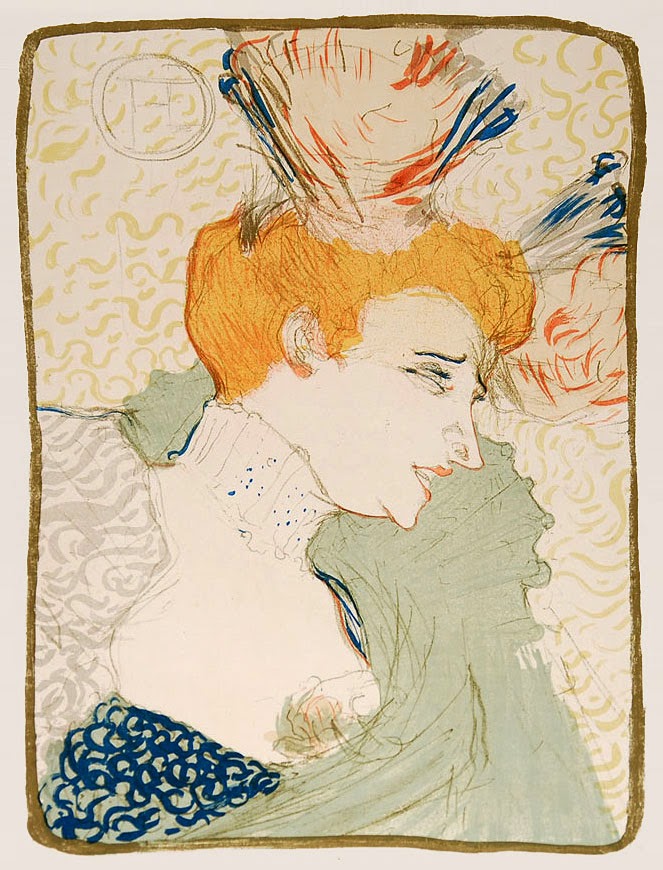
Henri de Toulouse-Lautrec (1864–1901) brought his posters, prints, and illustrations for journals and magazines to the masses in the late 1880s. His unique position as an artist who frequented both sides of the social spectrum permitted him access to artists, prostitutes, performers, authors, intellectuals, and society figures. His work shows different aspects of Parisian life and we follow his journeys between brothels, concert halls, the circus, racetracks and high society shindigs. He was embraced by the marginalized of Parisian society, although his ancestry ranked amongst the cultural elite. He drew what lay before him without discernment or preference. We see what he saw, and in some cases, it was a revelation to the gallery-going public, who marveled at the back of the house environments of actresses and singers. These were average people doing their jobs and relaxing with their friends, just any other group did, but to the upper crust of society, this was tantalizing, and dare I say it, a bit voyeuristic.
Toulouse-Lautrec’s manner of drawing was fluid and imbued his subjects with a quirked up sensibility. Many of his works can be described as colored drawings in paint. He excelled at capturing people in their working environment, and he felt for his subjects in both a sympathetic and dispassionate manner as one who suffered with them, as he surely did himself.
I chose to write about Toulouse-Lautrec (TL) number one because he’s a damned good artist, and secondly, because there is a large exhibition currently at the MOMA in New York. “The Paris of Toulouse-Lautrec: Prints and Posters” brings nearly 100 prints and posters out of MOMA’s vaults - showing now through March 22, 2015. This is the first MOMA exhibition in 30 years dedicated solely to Lautrec and his works on paper. The exhibition was organized by Sarah Suzuki, Associate Curator, Department of Drawings and Prints, at MOMA. Thank you for making this exhibition possible for us to see these marvelous works on paper! I encourage all my inked up comrades to unite and get yourselves to NYC to see this terrific show.
Following the topics of the MOMA show, I am presenting images which cover the Parisian cafés, dance halls and nightlife; actresses, singers and performers; prostitutes during non-working hours; some designs for song sheets; and horse racing.
Biography
Henri Marie Raymond de Toulouse-Lautrec Monfa was born at the Hotel du Bosc in Albi, Tarn in the Midi-Pyrenees region of France. He was the firstborn child of Comte Alphonse and Comtesse Adele de Toulouse-Lautrec, an aristocratic family (descendants of the Counts of Toulouse). The Comte and Comtesse themselves were first cousins, thus Henri suffered from congenital inbreeding which came to affect a lot of the European aristocracy.
After the death of his younger brother(possibly also due to inbreeding health issues), his parents separated and a nanny took care of Henri until he was eight years old. He then went to live with his mother in Paris, where he drew sketches and caricatures in his exercise workbooks.
At the age of 13 Henri fractured his left thigh bone, and at 14, the right. The breaks did not heal properly. His legs ceased to grow, so that as an adult he was only 5 ft. 1 in. tall, having an adult-sized torso, with child-sized legs. In 1875 Henri returned to Albi because his mother recognized his health problems. She consulted many doctors in the hope of finding a cure for her son's growth problem but to no avail. When it became apparent that TL would not be able to participate in most of the activities enjoyed by his peers or pursue a young society woman for a wife, he rejected his family’s social stature and turned to art.
He went to study under the portrait painter Léon Bonnat. Henri's mother had high ambitions of him becoming a fashionable and respected artist, but Toulouse-Lautrec was drawn to the famous Parisian bohemian neighborhood Montmartre, an area full of artists and writers. At this time he met Émile Bernard and Vincent van Gogh. Here, Toulouse-Lautrec also had his first encounter with a prostitute, which led him to paint these women in Montmartre. He spent a lot of his time in brothels, where he was accepted by the women and their madams. He even went to live in the brothels for a time, and in return they made him their confidant.
When the Moulin Rouge cabaret opened, it commissioned Toulouse-Lautrec to produce a series of advertisement posters. His mother had left Paris by then and Henri had a regular income from his family, but making the posters allowed him to make an additional wage of his own. The cabaret often reserved a seat for him, and displayed his paintings.
He eventually became an important Post-Impressionist painter, illustrator, and lithographer; and recorded many details of late-19th-century Parisian bohemian lifestyle. Toulouse-Lautrec also contributed a number of illustrations to the magazine Le Rire during the mid-1890s.
In 1887 he participated in an exposition in Toulouse using the pseudonym "Tréclau". He later exhibited in Paris with Van Gogh and Louis Anquetin. From 1889 until 1894, Henri took part in the "Independent Artists' Salon" on a regular basis.
Lautrec also turned to alcohol to drown his sorrows and block out the ridiculing he received from his aristocratic peers. By 1893 the drinking began to take its toll, and it was rumored that he also suffered from syphilis. In 1899 his mother had him briefly institutionalized. He died at the Chateau de Malrome before his 37th birthday from complications due to alcoholism and syphilis. He is buried in Verdelais, Gironde, close to the family’s estate.
After Toulouse-Lautrec's death, his mother and Maurice Joyant, his art dealer, promoted his art. His mother contributed funds for a museum to be built in Albi, his birthplace, to house his works, and there one can see some marvelous pieces by this soulful master.
While Toulouse-Lautrec’s short career spanned less than 20 years, he produced 737 canvases, 275 watercolors, 363 prints and posters and 5,084 drawings. I don't think anyone will ever tire of seeing this man's work. I am glad it is getting some attention, so pick up a glass, my inked up friends and toast to one of our best comrades.
Labels:
can-can,
Paris,
posters,
prostitutes,
Toulouse-Lautrec
Tuesday, December 16, 2014
The Warm Seduction of Karol Felix's Prints
Karol Felix is a printmaker extraordinaire from the central European Slovak Republic. Felix's work came to my attention after meeting a delegation of Slovak officials last year at Benedictine University. Felix's prints are also quite popular in exlibris circles.
His images swim between the Egyptian-influenced god-like statues, abstracted tattoo-like lettering, the occasional exposed breast and some mightily creepy, pointed fingers which direct the viewer through his compositions. The colors are warm and seductive, sepia browns, violet and greens. Even his open spaces are full of mark-making which leaves a history of ones passage through the surface.
In some of the work, Felix portrays a woman's face, frontal and lips parted in an unspoken, wanton invitation. Some of his prints feel like I am looking at a Dali figure, there one second, and then not there; evolving out of a mass of marks and brown, syrypy resin.
Felix's scale is moderately intimate, and draws the viewer to his work, but I have seen some larger pieces, and still the complex color combination do not loose their strength when their scale is enhanced. In all there is a sensuality of figuration, and surface.
His flip between balanced, frontal compositions and the more soupy, dreamy mixture of his other works work well together. The work is quite dependent upon the color to evoke his feelings. There is some mystery as to what the work is about, and the hieroglyphic-influenced pieces call us back to the mysteries of learning the ancient symbolic script.
These works are rich and inviting, and the man is a master of his craft.We can only hope he will gain more western recognition for his work. Benedictine University(in Lisle, IL) has a number of his prints in their permanent collection.
Biography
1961 Born, in Košice (Slovakia)
Education:
1980-81 Studied at the Teachers Training College, in Nitra.
1981-87 Studied at Academy of Fine Arts, Bratislava
Department of Graphic Art and Book Illustrations with Prof. Albín Brunovský
1987-88 Army Artistic Studio, Prague, Czech Republic
1988-89 Ľudovít Fulla Scholarship
Residency:
1990 Frans Masereel Centrum Kasterlee (Belgium)
collaboration with printer Martin Štěpánek
1991 Foundation Taylor, Paris (France)
1996 Co-founder of the Union of Graphic Artists G-Point Group
Contact:
Tel. +421 37 7411692
kfelix@naex.sk, zbyso@karolfelix.com
Mailing address:
Jána Galbavého 5
949 01 Nitra
Slovakia, Europe
Labels:
breats,
Egyptian hieroglyphics,
exlibris,
Karol Felix,
Slovak
Tuesday, December 2, 2014
Chicago's Own Printmaker, Eldzier Cortor
The joy of this blog is when I find some new, or elder, printmaker’s work that I haven’t seen before. We have some mighty fine colleagues out there, and Eldzier Cortor is one of the good ones. I hope you enjoy his work as much as I do. Recently, a major gift of Cortor’s work was given to the Art Institute of Chicago, and anyone can make an appointment go see Cortor’s prints in their fabulous Print & Drawing Room.
Notable for his prints and paintings, African-American artist and printmaker Eldzier Cortor was born in 1916, in Tidewater, VA, to John and Ophelia Cortor. His family was a part of the Great Migration of African Americans from the rural south to the industrial north at the beginning of the 1900s. His family moved to the south side of Chicago when Cortor was about a year old. He later attended Englewood High School with other notable African-American artists, such as Margaret Burroughs and Charles Wilbert White.
He attended the Art Institute of Chicago, gaining a degree in 1936. While there, he came under the influence of instructor Kathleen Blackshear, who led students to explore the regional arts of Africa and other non-Western cultures at University of Chicago’s Oriental Institute, and the Field Museum. Studying the African sculptures at the Field Museum transformed his work. "That was the most important influence in all my work, for to this day you will find in my handling of the human figure that cylindrical and lyrical quality I was taught...to appreciate in African art."
He also studied at the Institute of Design. Cortor, like his peers in the Harlem Renaissance, sought to reclaim his ancestral heritage as a means of informing and empowering his art. He searched for positive Black imagery, which he found in Chicago’s South Side working-class, in the former slave cultures of the U.S. South and Caribbean, and, finally, in the iconic Black female figure.
In 1940 he worked with the Works Progress Administration (WPA), where he drew scenes of Depression-era Bronzeville, a near south side Chicago neighborhood. Cortor received two Rosenwald Foundation grants, in 1944 and 1945, to live with the Gullah people in the Sea Islands off the coast of Georgia and South Carolina. In 1949, Cortor received a Guggenheim Fellowship to study in Jamaica, Cuba, and Haiti, and he taught at the Centre d'Art in Port-au-Prince from 1949–1951.
During his career, Cortor produced several prints in the mid-1950s with Japanese printmaker Jun’ichiro Sekino, who was a leading member of the Sosaku Hanga, or Creative Prints, movement. Between 1955 and 1998, he made experimental prints at New York’s famous Robert Blackburn’s Printmaking Workshop.
Cortor was one of the first African-American artists to make African-American women his primary theme, saying, "the Black woman represents the Black race, continuance of life." These women have been a central focus of Eldzier Cortor’s work for much of his career; their elongated sculptural features appearing timeless and modern. It was when Cortor lived with the Gullah people that he became fascinated with their deep cultural African ties to their ancestry, and this prompted him to depict Woman as an archetypal image.
Cortor’s work is also influenced by surrealism, "who often uses the female figure in a surreal interior and exterior environment." While much of his work displays a strength and hopefulness, other series, such as his Haitian-influenced slaughterhouse series speak of suffering, oppression and racism. The lasting impression of Cortor’s work shows his pride of his ancestry, and love of the female form. These compositions show off, unabashedly, Cortor’s free expressive color, form and loose compositions; and the female nude as tall, lean powerful and sensual figures. His gift to the Art Institute of Chicago cannot be diminished in importance because he is one of the major figures of Chicago’s African American art scene. We can only hope to see more of his work as he continues to make art, and especially prints.
Exhibitions:
1938 - "An Exhibition in Defense of Peace and Democracy", the Chicago Artists' Group
1940 - "The Exhibition of the Art of the American Negro", in Chicago.
1967 - City College of New York, "The Evolution of Afro-American Artists: 1800 - 1950"
1976 - Los Angeles County Museum of Art, "Two Centuries of Black American Art", (which toured the U.S. in 1977.)
1988 - "Three Masters", Kenkeleba Gallery, NY, (with Hughie Lee-Smith and Archibald Motley)
2002 - "Eldzier Cortor: Master Printmaker", Boston Psychoanalytic Society and Institute, MA
2010 - Library of Congress, Washington, D.C.
2010 - Indiana University Art Museum, Bloomington, IN
2013 - San Antonio Museum of Art, TX
Collections:
Howard University
The Smithsonian American Art Museum
The Art Institute of Chicago
Awards:
Art Institute of Chicago, Advisory Committee’s Legends and Legacy Award
Publications:
Matthew Backer and Jennifer Heusel, “Black Spirit”: Works on Paper by Eldzier Cortor (Indiana University Art Museum, 2006).
Notable for his prints and paintings, African-American artist and printmaker Eldzier Cortor was born in 1916, in Tidewater, VA, to John and Ophelia Cortor. His family was a part of the Great Migration of African Americans from the rural south to the industrial north at the beginning of the 1900s. His family moved to the south side of Chicago when Cortor was about a year old. He later attended Englewood High School with other notable African-American artists, such as Margaret Burroughs and Charles Wilbert White.
He attended the Art Institute of Chicago, gaining a degree in 1936. While there, he came under the influence of instructor Kathleen Blackshear, who led students to explore the regional arts of Africa and other non-Western cultures at University of Chicago’s Oriental Institute, and the Field Museum. Studying the African sculptures at the Field Museum transformed his work. "That was the most important influence in all my work, for to this day you will find in my handling of the human figure that cylindrical and lyrical quality I was taught...to appreciate in African art."
He also studied at the Institute of Design. Cortor, like his peers in the Harlem Renaissance, sought to reclaim his ancestral heritage as a means of informing and empowering his art. He searched for positive Black imagery, which he found in Chicago’s South Side working-class, in the former slave cultures of the U.S. South and Caribbean, and, finally, in the iconic Black female figure.
In 1940 he worked with the Works Progress Administration (WPA), where he drew scenes of Depression-era Bronzeville, a near south side Chicago neighborhood. Cortor received two Rosenwald Foundation grants, in 1944 and 1945, to live with the Gullah people in the Sea Islands off the coast of Georgia and South Carolina. In 1949, Cortor received a Guggenheim Fellowship to study in Jamaica, Cuba, and Haiti, and he taught at the Centre d'Art in Port-au-Prince from 1949–1951.
During his career, Cortor produced several prints in the mid-1950s with Japanese printmaker Jun’ichiro Sekino, who was a leading member of the Sosaku Hanga, or Creative Prints, movement. Between 1955 and 1998, he made experimental prints at New York’s famous Robert Blackburn’s Printmaking Workshop.
Cortor was one of the first African-American artists to make African-American women his primary theme, saying, "the Black woman represents the Black race, continuance of life." These women have been a central focus of Eldzier Cortor’s work for much of his career; their elongated sculptural features appearing timeless and modern. It was when Cortor lived with the Gullah people that he became fascinated with their deep cultural African ties to their ancestry, and this prompted him to depict Woman as an archetypal image.
Cortor’s work is also influenced by surrealism, "who often uses the female figure in a surreal interior and exterior environment." While much of his work displays a strength and hopefulness, other series, such as his Haitian-influenced slaughterhouse series speak of suffering, oppression and racism. The lasting impression of Cortor’s work shows his pride of his ancestry, and love of the female form. These compositions show off, unabashedly, Cortor’s free expressive color, form and loose compositions; and the female nude as tall, lean powerful and sensual figures. His gift to the Art Institute of Chicago cannot be diminished in importance because he is one of the major figures of Chicago’s African American art scene. We can only hope to see more of his work as he continues to make art, and especially prints.
Exhibitions:
1938 - "An Exhibition in Defense of Peace and Democracy", the Chicago Artists' Group
1940 - "The Exhibition of the Art of the American Negro", in Chicago.
1967 - City College of New York, "The Evolution of Afro-American Artists: 1800 - 1950"
1976 - Los Angeles County Museum of Art, "Two Centuries of Black American Art", (which toured the U.S. in 1977.)
1988 - "Three Masters", Kenkeleba Gallery, NY, (with Hughie Lee-Smith and Archibald Motley)
2002 - "Eldzier Cortor: Master Printmaker", Boston Psychoanalytic Society and Institute, MA
2010 - Library of Congress, Washington, D.C.
2010 - Indiana University Art Museum, Bloomington, IN
2013 - San Antonio Museum of Art, TX
Collections:
Howard University
The Smithsonian American Art Museum
The Art Institute of Chicago
Awards:
Art Institute of Chicago, Advisory Committee’s Legends and Legacy Award
Publications:
Matthew Backer and Jennifer Heusel, “Black Spirit”: Works on Paper by Eldzier Cortor (Indiana University Art Museum, 2006).
Subscribe to:
Posts (Atom)

.jpg)
.jpg)
.jpg)

.jpg)
.jpg)


_La_charette_anglaise_Lithographie_Arches_France_5848.jpg)