Showing posts with label Pop art. Show all posts

Thursday, February 14, 2019

Nothing Says LOVE like Robert Indiana


Robert Indiana (born Robert Clark, 1928 – 2018) was an American artist associated with the Pop Art movement. He was also a theatrical set and costume designer.
Indiana was born in New Castle, Indiana. He moved to Indianapolis to attend Arsenal Technical High School (1942–1946), from which he graduated as valedictorian of his class. After serving in the United States Army Air Forces, Indiana studied at the Art Institute of Chicago (1949–1953) and Edinburgh University and Edinburgh College of Art (1953–1954). He settled in New York City after returning to the United States in 1954.

Indiana lived and worked in a five-story building at Spring Street and the Bowery. In 1973, he bought a lodge in Vinalhaven, Maine where he later resided until his death in 2018.


The bulk of Indiana's work consists of iconic words like his best known piece, called LOVE, in upper-case letters, arranged in a square with a tilted letter "O". The piece originally appeared in a series of poems written in 1958. The image was used for a Christmas card for the Museum of Modern Art in 1964, and as an eight-cent U.S. Postal Service postage stamp in 1973.

The first print of "Love" was printed as part of an exhibition poster in 1966.

In 1977, he created a sculptural Hebrew version of LOVE for the Israel Museum Art Garden, in Jerusalem.
In 2008, Indiana created an image showcasing the word "HOPE", and donated all proceeds from the sale of reproductions to Democrat Barack Obama's presidential campaign, raising in excess of $1,000,000.

For Valentine's Day 2011, he created a similar variation on LOVE for Google, which was displayed on the search engine site's logo.


Between 1989 and 1994, Indiana painted 18 works inspired by the war motifs paintings of Marsden Hartley.
He was the star of Andy Warhol's film Eat (45 minute, 1964), which is a film of Indiana eating a mushroom. Warhol also made the brief silent film Bob Indiana Etc. (4 minutes, 1963), as a portrait of the artist.

In 1964, the architect Philip Johnson commissioned one of Indiana’s pieces for the New York State Pavilion at the World's Fair.


Selected Public Collections
Albright-Knox Gallery, Buffalo, NY
Baltimore Museum of Art, MD
Carnegie Institute, Pittsburgh, PA
Delaware Art Museum, Wilmington; DE
Detroit Institute of Art, MI
the Hirshhorn Museum in Washington, D.C.
Indianapolis Museum of Art, IN
Institute of Contemporary Art, University of Pennsylvania, Philadelphia, PA
Israel Museum, Jerusalem
Los Angeles County Museum of Art, CA
McNay Art Museum, San Antonio, TX
Metropolitan Museum of Art, NY
Museum of Modern Art, NY
San Francisco Museum of Modern Art, CA
Stedelijk Museum, Amsterdam, The Netherlands
Whitney Museum of American Art, NY

Thursday, July 17, 2014

Wayne Thiebaud's Rollicking Ride with Icing on Top


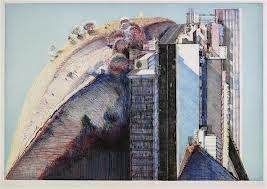
I have been enamored of Wayne Thiebaud’s work since I first saw it. His often electrifying colors, even used as shadows, show a masterful knowledge of color at its most evocative and seductive. He slathers on the brushwork like icing a cake, and admit it, don’t all of us have a hankering for some ‘sugary thang’ after seeing one of his cake and pie images? Admit it. Yes, you do. The man has made a lifelong pursuit of American subjects: diner food, and observations of landscape/cityscape, but he has always worked from life. He shows them off with such a finely orchestrated composition, you can't help wanting to devour one of his tasty morsels, or ride one of his extreme roller coaster California streetscapes.
The fact that Thiebaud has been doing prints is no surprise to us. His drawn line is simultaneously expressive and diagrammatic. His play with head-on compositions and asymmetry reminds us of the work of Jim Dine and Richard Diebenkorn. His printed surfaces are just as seductive as his paintings. The man knows his craft, so we can sit back and enjoy the linear ride, so to speak. Take a look at these gems....

Wayne Thiebaud, b.1920- is an American artist known for his luscious, brightly-painted still-lifes of production line objects found in diners and cafeterias, such as pies and pastries. As a young man in Long Beach, he worked at a cafe named Mile High and Red Hot, where "Mile High" was ice cream and "Red Hot" was a hot dog. He also chose to paint landscapes and cityscapes of northern California and San Francisco.
Thiebaud was born in Meza, Arizona, and grew up in a Mormon home in Hurricane, Utah and Long Beach, California. He studied commercial art at Long Beach Polytechnic High School and at the Frank Wiggins Trade School (a.k.a. Los Angeles Trade-Technical College) in Los Angeles and worked as a summer apprentice in the animation department at Walt Disney Studios. From 1939 to 1949 Thiebaud worked as a cartoonist, sign painter, and illustrator. He served as an artist in the First Motion Picture Unit of the United States Army Air Forces from 1942 to 1945. He attended San Jose State College (1949–50) and California State College at Sacramento (B.A. 1951/ M.A. 1953).

Thiebaud taught art at Sacramento Junior College (now Sacramento City College) from 1951 - 1960, and from 1960 -1990 he taught art at the University of California, Davis. He was active in theatre design work, created public murals and sculptures, and in 1954 he established a company to produce educational art films.

While on sabbatical, he lived for a year in New York City in 1956–57, became friends with Elaine and Willem de Kooning, and came under the influence of the Abstract Expressionists, the Bay Area figurative movement, and predate proto-pop artists Robert Rauschenberg and Jasper Johns. By the ’50s his work employed the thick, gestural brushstroke for everyday subjects: pinball machines, bakery counters, cosmetics—rendering them in bright colors and strong light. He also co-founded the Artists Cooperative gallery, now Artists Contemporary Gallery, and other cooperatives including Pond Farm, having been exposed to cooperatives in New York.
In the 60’s Thiebaud turned to landscapes, but made them abstract using strange and unusual angles and vantage points. His streetscapes, and cityscapes were influenced by the work of Richard Diebenkorn. His works are noted for their austere hyper-realism, and have been compared to the work of Edward Hopper and Jim Dine. In 1962, Thiebaud's work was included (with Roy Lichtenstein, Andy Warhol, Jim Dine, Phillip Hefferton, Joe Goode, Edward Ruscha, and Robert Dowd) in the ground-breaking "New Painting of Common Objects," at the Pasadena Art Museum (now the Norton Simon Museum of Art at Pasadena). This exhibition is historically considered one of the first Pop Art exhibitions in America.

Exhibitions/Awards:
1962 - Sidney Janis Gallery, New York
1984 - Special recognition award, National Association of Schools of Art and Design
1985 - American Academy and Institute of Arts and Letters, NY
1986 - Associate of National Academy of Design, NY
1988 - Honorary Doctorate Award, San Francisco Art Institute, San Francisco, CA
1988 - Fellow to the American Academy of Arts and Sciences, Boston, MA
1994 - National Medal of Arts, from President William Jefferson Clinton
1996 - The Gold Medal for Lifetime Achievement in the Arts Award from the National Arts Club, NY
1996 - Award of Excellence from the National Park Service
2001 - Lifetime Achievement Award for Art from the American Academy of Design, NY

Collections:
Museum of Modern Art, NY, the San Francisco Museum of Modern Art, CA, and the Art Institute of Chicago, IL
Thiebaud once said, "An artist has to train his responses more than other people do. He has to be as disciplined as a mathematician. Discipline is not a restriction but an aid to freedom. It prepares an artist to choose his own limitations…"

Clearly, these prints demonstrate a love of line, and entice us with what we see and what is left unseen. Our thirst for his images is unquenched, our cravings for more unsatisfied; for we can Never get enough of Thiebaud's keyed up color, his delicately simple enticements of rows and rows of candy and all things sugary. but I especially enjoy his challenge to reinvent the hillsides of California into the scariest and best ever thrill-seeker rides of our lives. Anything on those streets on wheels is in for one rollicking ride, my friends.

Sunday, May 4, 2014

The 'Wham!' of Roy Lichtenstein's Prints

You can love him or not, but you can't ignore him. Roy Lichtenstein's prints are signature works during the Pop Art movement in the 1960s. His simplistic use of only 20 colors during his career is interesting by itself, but the complexity of the images and the way he maneuvered himself seamlessly out of the Pop art period to explore other icons of the 20th c. was and is a fascinating education in how an artist teaches himself to become a better artist.
Roy Fox Lichtenstein 1923 –1997 was a part of the American Pop Art movement. During the 1960s, he became a leading figure in the new American-dominated movement, along with fellow artists Andy Warhol, Jasper Johns, and James Rosenquist. Using comic strips as his main inspiration, Lichtenstein created tongue-in-cheek, hard-edged compositions in clean, crisp primary colors. His work was also heavily influenced by popular advertising. He described pop art as "not 'American' painting but actually industrial painting". During his career, Lichtenstein made over 300 prints, mostly in screen printing.
Lichtenstein was born in New York City, into an upper-middle-class Jewish family, where his father was a real estate broker, and his mother, a homemaker. He attended public school for a time, then enrolled at New York's Franklin School for Boys. Lichtenstein first became interested in art and design as a hobby, and then through school. In 1939, Lichtenstein enrolled in summer classes at the Art Students League of New York, where he worked under Reginald Marsh. Being an avid fan of jazz music, he frequently drew portraits of Harlem’s Apollo Theater jazz musicians while playing their instruments.
Lichtenstein went to study art at the Ohio State University. His studies were interrupted for three years (1943-1946) while he served as an orderly, draftsman, and artist in the Army during and after World War II. He returned home to visit his dying father and was discharged from the army with eligibility for the G.I. Bill. He returned to OSU and studied under Hoyt L. Sherman, who is widely regarded to have had a significant impact on his work (Lichtenstein would later name a studio the Hoyt L. Sherman Studio Art Center after his mentor). Lichtenstein continued his graduate studies at OSU, was hired as an art instructor, and received his Master of Fine Arts degree in 1949.

In 1957, he moved to upstate New York and began teaching at the State University of New York at Oswego. In 1960, he started teaching at Rutgers University alongside Allan Kaprow. In 1961-1965, Lichtenstein began his first pop images using cartoons and commercial printing techniques. Leo Castelli started displaying his work at his gallery in New York in 1961 and he had his first one-man show in 1962; the entire collection was bought by influential collectors before the show even opened. In September 1963 he took a leave of absence from teaching to focus time on his artwork.
"I think my work is different from comic strips -- but I wouldn't call it transformation; I don't think that whatever is meant by it is important to art".
Lichtenstein reproduced masterpieces by Cézanne, Mondrian and Picasso before embarking on his Brushstroke series in 1965. The Los Angeles County Museum of Art commissioned him to make a film with the help of Universal Film Studios. It was called Three Landscapes, about marine landscapes, directly related to a series of collages with landscape themes he created between 1964 - 1966.
Also in 1970, Lichtenstein purchased a former carriage house in Southampton, Long Island, built a studio on the property, and spent the rest of the 1970s in relative seclusion. Over the next ten years his style began to loosen and he expanded on what he had done before.
During a trip to Los Angeles in 1978, Lichtenstein was fascinated by lawyer Robert Rifkind's collection of German Expressionist prints and illustrated books. Small colored-pencil drawings were used as templates for woodcuts, a medium favored by Emil Nolde and Max Pechstein, as well as Dix and Ernst Ludwig Kirchner. A major series of Surrealist-Pop artwork from 1979–81 is based on Native American themes. Having been inspired by Edgar Degas’ monochromatic prints from a show at the Metropolitan Museum of Art, he created the motifs of his Landscapes in the Chinese Style series are formed with simulated Benday dots and block contours, rendered in hard, vivid color, with all traces of the hand removed.

Lichtenstein married twice, once to Isabel Wilson, with whom he had two sons, and again to Dorothy Herzka. From 1970 until his death, Lichtenstein split his time between Manhattan and Southampton. He also had a home on Captiva Island. He was committed to his art until the end of his life, often spending at least 10 hours a day in his studio. In 1997, he died of pneumonia in New York.
Commissions
1964 New York State Pavilion, World's Fair, New York City.
1969 bedroom suite painting for Gunter Sachs, Palace Hotel, St. Moritz.
late 1970s - 1980s, major commissions for works in public places: the sculptures in Miami Beach; at Port Columbus International Airport; the Equitable Center, New York; and Barcelona.
1994 Times Square Mural , Times Square subway station.
1977 paint a Group 5 Racing Version of the BMW 320i for the BMW Art Car Project.
1977 Skowhegan Medal for Painting, Skowhegan School, Skowhegan, Maine.
1979 American Academy of Arts and Letters, New York.
1989 American Academy in Rome, Rome, Italy. Artist in residence.
1991 Creative Arts Award in Painting, Brandeis University, Waltham, Massachusetts.
1993 Amici de Barcelona, from Mayor Pasqual Maragall, L’Alcalde de Barcelona.
1995 Kyoto Prize, Inamori Foundation, Kyoto, Japan.
1995 National Medal of the Arts, Washington D.C.
The DreamWorks Records logo – last design project

Awards
1995 National Medal of Arts

Education
Parsons School of Design, The Ohio State University, Art Students League, Franklin School for Boys (now Dwight School)
Honorary Doctorate degrees:
George Washington University (1996),Bard College, Royal College of Art (1993), Ohio State University (1987), Southampton College (1980), and the California Institute of the Arts (1977).

Exhibitions
1967 first museum retrospective exhibition, Pasadena Art Museum, CA
1967 first solo exhibition in Europe at museums in Amsterdam, London, Bern and Hannover
1968 participated in documenta IV
1977 participated in documenta VI
1994 second retrospective, the Guggenheim Museum, NY
1987 first living artist to have a solo drawing exhibition, Museum of Modern Art from
2010 "Roy Lichtenstein: Meditations on Art" Museo Triennale, Milan
2010 The Morgan Library & Museum
2012 major retrospective at the Art Institute of Chicago, National Gallery of Art in Washington, Tate Modern
2013 major retrospective at the Centre Pompidou in Paris
Collections
1996 the National Gallery of Art, Washington, D.C. – largest single repository
The Art Institute of Chicago
Dorothy Lichtenstein, and of the Roy Lichtenstein Foundation
Museum Ludwig, Cologne
National Gallery of Australia's Kenneth Tyler Collection