A place for talking about art, social issues, and most anything else I think THAT'S INKED UP.
Showing posts with label Richard Diebenkorn. Show all posts
Tuesday, June 16, 2015
Richard Diebenkorn Prints at the de Young Museum
Oh, Yessssss! It’s about time, my fellow inked up friends! This is a show worth seeing, taking in the breadth of printed works created by American artist extraordinaire, Richard Diebenkorn. The de Young Museum, located in San Francisco, California, is hosting an exhibition of Diebenkorn’s work, that every printmaker should be hitting the road this summer and heading out to San Francisco to see.
Selections from a recent acquisition of 160 prints, acquired by the de Young’s Phyllis C. Wattis Fund for Major Accessions, and the generosity of Diebenkorn’s widow, Phyllis, comprise an excellent and overdue exhibition of Diebenkorn’s energetic love for the printmaking medium. This exhibition provides an overview of his printed accomplishments and includes a number of unpublished prints and proofs that were not a part of his known editions.
This is just a wonderful group of works, my friends. Diebenkorn was known as a painter, but his prints also demonstrate his love of drawing, and his ability to transcend a color field glaze to the translucent tones only found in printmaking. He understood so well the use of line to define the contour of an object or a figure, and how to use that same line to minimally and eloquently define terrain and create immeasurable distance.
The colors, when he chooses to use them remind me a bit, of Wayne Thiebaud, but Diebenkorn’s colors are richer and more earthy. His time in New Mexico left an indelible impression upon him of the saturation of the southwestern colors, but his lighter, more lyrical pieces remind us of his color field work and the colors one only sees in the California sun-drenched landscape.
Diebenkorn brings his love of drawing to the printed matrix, and the richness of his blacks are good enough to eat. Really, this man’s printed work is as masterful as his paintings and drawings. This is, simply put, a show you cannot miss. Run, my friends, and drink in the beauty of these pieces. I assure you, you will not be disappointed.
Richard Clifford Diebenkorn Jr. (1922 –1993) was an American artist whose art was associated with abstract expressionism and the Bay Area Figurative Movement of the 1950s and 1960s. Diebenkorn was born in Portland, Oregon, but he lived most of his life in California. He studied art at Stanford University, under instructors Victor Arnautoff and Daniel Mendelowitz, before serving in the United States Marine Corps, 1943-1945.
In 1946, Diebenkorn enrolled at the California School of Fine Arts in San Francisco, where he later taught art from 1947-1950. It was there he started to make prints, which he continued to produce until his death. From 1950-1952, Diebenkorn went to the University of New Mexico for his Masters of Fine Arts degree. He then moved back to California and settled in Berkeley, living there until 1966.
By the mid-1950s, Diebenkorn became an important painter, whose style moved between a figuration similar to Henri Matisse to an abstract expressionism clearly his own. He was also influenced by fellow abstract painters Clyfford Still, Arshile Gorky and Willem de Kooning. Although Diebenkorn was a leader of the abstract painting movement in California, and well-respected, he did not receive proper attention from the east coast art critics.
In 1967, Diebenkorn moved to Santa Monica and taught art at UCLA until 1973. That same year, he shifted his subject matter from expressionism to a geometric style, called the "Ocean Park" series. They were based on the aerial landscape of Santa Monica, where he had his studio.
Diebenkorn died in 1993 from complications due to emphysema.
Awards
1991-National Medal of Arts
1979-National Academy of Design
Public Collections:
Albertina Museum, Austria
Albright–Knox Art Gallery, NY
Art Institute of Chicago, IL
Baltimore Museum of Art, MA
Carnegie Institute, PA
Corcoran Gallery of Art, Washington, D.C.
the de Young Museum, CA
Hirshhorn Museum and Sculpture Garden, Washington, D.C.
Los Angeles County Museum of Art, CA
New Mexico Museum of Art, NM
Phillips Collection, Washington, D.C.
San Francisco Museum of Modern Art, CA
Solomon R. Guggenheim Museum, NY
the Whitney Museum of American Art, NY
Stanford University’s Iris & B. Gerald Cantor Center for Visual Arts has 29 of Diebenkorn's sketchbooks, and other works on paper.
The de Young is located at Golden Gate Park | 50 Hagiwara Tea Garden Drive, San Francisco, CA 94118 | 415.750.3600
Thursday, July 17, 2014
Wayne Thiebaud's Rollicking Ride with Icing on Top
I have been enamored of Wayne Thiebaud’s work since I first saw it. His often electrifying colors, even used as shadows, show a masterful knowledge of color at its most evocative and seductive. He slathers on the brushwork like icing a cake, and admit it, don’t all of us have a hankering for some ‘sugary thang’ after seeing one of his cake and pie images? Admit it. Yes, you do. The man has made a lifelong pursuit of American subjects: diner food, and observations of landscape/cityscape, but he has always worked from life. He shows them off with such a finely orchestrated composition, you can't help wanting to devour one of his tasty morsels, or ride one of his extreme roller coaster California streetscapes.
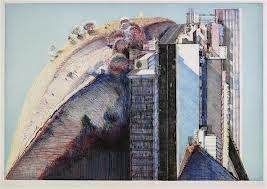
The fact that Thiebaud has been doing prints is no surprise to us. His drawn line is simultaneously expressive and diagrammatic. His play with head-on compositions and asymmetry reminds us of the work of Jim Dine and Richard Diebenkorn. His printed surfaces are just as seductive as his paintings. The man knows his craft, so we can sit back and enjoy the linear ride, so to speak. Take a look at these gems....
Wayne Thiebaud, b.1920- is an American artist known for his luscious, brightly-painted still-lifes of production line objects found in diners and cafeterias, such as pies and pastries. As a young man in Long Beach, he worked at a cafe named Mile High and Red Hot, where "Mile High" was ice cream and "Red Hot" was a hot dog. He also chose to paint landscapes and cityscapes of northern California and San Francisco.
Thiebaud was born in Meza, Arizona, and grew up in a Mormon home in Hurricane, Utah and Long Beach, California. He studied commercial art at Long Beach Polytechnic High School and at the Frank Wiggins Trade School (a.k.a. Los Angeles Trade-Technical College) in Los Angeles and worked as a summer apprentice in the animation department at Walt Disney Studios. From 1939 to 1949 Thiebaud worked as a cartoonist, sign painter, and illustrator. He served as an artist in the First Motion Picture Unit of the United States Army Air Forces from 1942 to 1945. He attended San Jose State College (1949–50) and California State College at Sacramento (B.A. 1951/ M.A. 1953).
Thiebaud taught art at Sacramento Junior College (now Sacramento City College) from 1951 - 1960, and from 1960 -1990 he taught art at the University of California, Davis. He was active in theatre design work, created public murals and sculptures, and in 1954 he established a company to produce educational art films.
While on sabbatical, he lived for a year in New York City in 1956–57, became friends with Elaine and Willem de Kooning, and came under the influence of the Abstract Expressionists, the Bay Area figurative movement, and predate proto-pop artists Robert Rauschenberg and Jasper Johns. By the ’50s his work employed the thick, gestural brushstroke for everyday subjects: pinball machines, bakery counters, cosmetics—rendering them in bright colors and strong light. He also co-founded the Artists Cooperative gallery, now Artists Contemporary Gallery, and other cooperatives including Pond Farm, having been exposed to cooperatives in New York.In the 60’s Thiebaud turned to landscapes, but made them abstract using strange and unusual angles and vantage points. His streetscapes, and cityscapes were influenced by the work of Richard Diebenkorn. His works are noted for their austere hyper-realism, and have been compared to the work of Edward Hopper and Jim Dine. In 1962, Thiebaud's work was included (with Roy Lichtenstein, Andy Warhol, Jim Dine, Phillip Hefferton, Joe Goode, Edward Ruscha, and Robert Dowd) in the ground-breaking "New Painting of Common Objects," at the Pasadena Art Museum (now the Norton Simon Museum of Art at Pasadena). This exhibition is historically considered one of the first Pop Art exhibitions in America.
Exhibitions/Awards:
1962 - Sidney Janis Gallery, New York
1984 - Special recognition award, National Association of Schools of Art and Design
1985 - American Academy and Institute of Arts and Letters, NY
1986 - Associate of National Academy of Design, NY
1988 - Honorary Doctorate Award, San Francisco Art Institute, San Francisco, CA
1988 - Fellow to the American Academy of Arts and Sciences, Boston, MA
1994 - National Medal of Arts, from President William Jefferson Clinton
1996 - The Gold Medal for Lifetime Achievement in the Arts Award from the National Arts Club, NY
1996 - Award of Excellence from the National Park Service
2001 - Lifetime Achievement Award for Art from the American Academy of Design, NY
Collections:
Museum of Modern Art, NY, the San Francisco Museum of Modern Art, CA, and the Art Institute of Chicago, IL
Thiebaud once said, "An artist has to train his responses more than other people do. He has to be as disciplined as a mathematician. Discipline is not a restriction but an aid to freedom. It prepares an artist to choose his own limitations…"
Clearly, these prints demonstrate a love of line, and entice us with what we see and what is left unseen. Our thirst for his images is unquenched, our cravings for more unsatisfied; for we can Never get enough of Thiebaud's keyed up color, his delicately simple enticements of rows and rows of candy and all things sugary. but I especially enjoy his challenge to reinvent the hillsides of California into the scariest and best ever thrill-seeker rides of our lives. Anything on those streets on wheels is in for one rollicking ride, my friends.
Subscribe to:
Posts (Atom)


.jpg)